
What it means for a stock to be shorted.
A short transaction looks like this:
-
A short transaction follows this process:
- Entity A owns shares in a company, such as Pilbara Minerals (ASX:PLS) – currently the most shorted stock on the ASX at 20.2% shorted. Entity A is usually a long-term holder, often an ETF replicating an index. Examples include State Street, VanEck, and BlackRock.
- Entity B believes Pilbara Minerals is overvalued and wants to short it. Entity B is typically a hedge fund manager or professional trader, not a retail investor. While they can be wrong, they are usually more sophisticated than the average market participant.
- Entity B borrows shares from Entity A, paying a small, ongoing fee.
- Entity B sells the borrowed shares on the market at the current price (e.g., $5 per share). They now hold the sale proceeds but still owe the shares back to Entity A.
- Entity B hopes for the price to fall so they can buy back the shares at a lower price and return them to Entity A, profiting from the difference. However, the cost of borrowing the shares must be deducted from their profits.
Are there any other reasons why a stock may be shorted?
While the primary reason for shorting is a belief that the stock will decline, there are other strategies that involve short selling, such as a pairs trade.
- Pairs trading occurs when a trader believes one stock will outperform another. They take a long position in the stronger stock and a short position in the weaker stock.
- The strategy works regardless of whether both stocks rise or fall – what matters is that the long position performs better than the short position.
- Example: When Amazon (NASDAQ:AMZN) entered the Australian market, a theoretical pairs trade would have been to go long Amazon and short Harvey Norman (ASX:HVN), anticipating that online retail would outgrow traditional retail.
- With hindsight, this would have been a highly successful trade.
What happens when the short sellers get it wrong?
- Pilbara Minerals has a market cap of $11.9B, with 20% shorted (i.e., $2.4B worth of stock).
- Average daily trading volume is ~$94M, meaning it would take 25 days of typical trading volume to cover the short position.
- This huge demand for buying shares to close short positions can lead to a short squeeze.
What is a Short Squeeze?
A short squeeze occurs when many short sellers rush to buy back shares at the same time, pushing the stock price sharply higher.
- Unlike a long position, where the maximum loss is 100% of the investment, the potential loss on a short trade is theoretically infinite.
- Short squeezes have led to some of the most dramatic price spikes in history.
Examples:
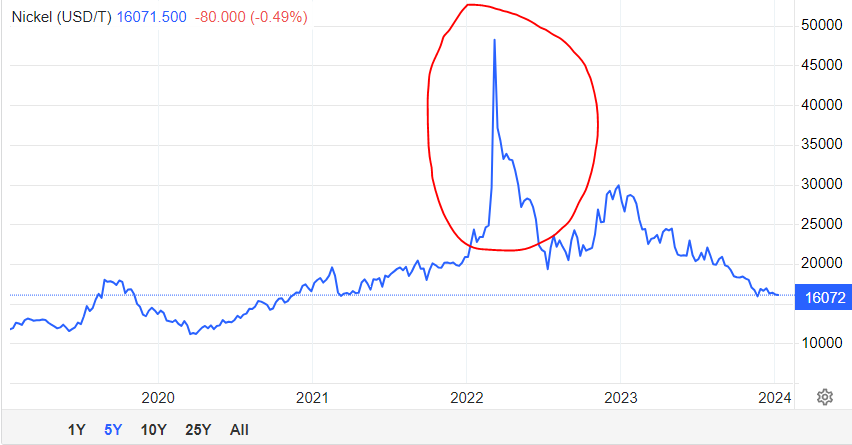
- Nickel was squeezed in early 2021, causing extreme price movements.
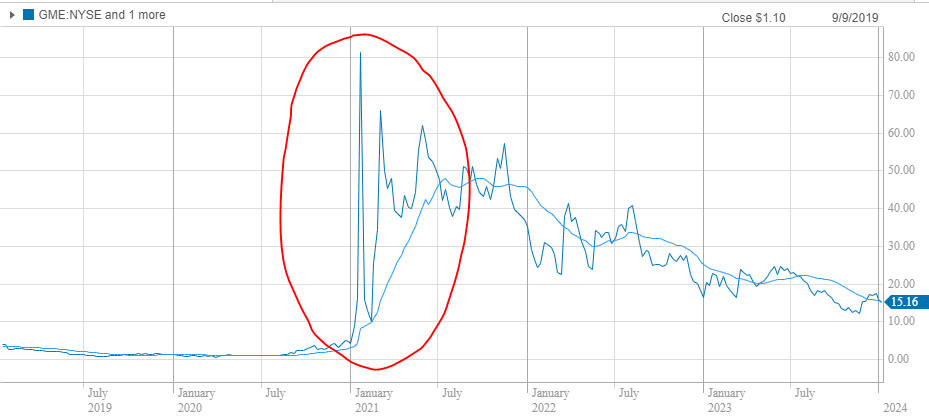
- GameStop (NYSE:GME) experienced a historic short squeeze, as seen in the movie Dumb Money.
Final thoughts: Short Selling: An explanation
If I own a stock with a high short interest, I pay close attention:
- Why are traders shorting it?
- Is there something I am missing?
Short sellers are formidable market participants. However, if my research and conviction remain strong, and I am ultimately correct, the potential upside can be significant and rapid.
Disclaimer: This information is provided purely for educational purposes. It takes no account of an individual’s personal financial circumstances and hence can in no way constitute financial advice. The above data may be subject to errors or inconsistencies for which the author takes no liability. It is imperative that all investors do their own research or if they need advice, seek it from a qualified financial adviser.
Short Selling: An explanation