
This is a restricted members post.
Author: Nathan
Analyst Call 13/11/24 Summary
Summary of Nuix Shareholder / Analyst Call 13/11/24
- Here are the 10 key points from the Nuix Shareholder / Analyst Call 13/11/24:
- Meeting Overview: The meeting was led by Nuix’s Chairman, Robert Mactier, who opened by acknowledging traditional land custodians and outlined the meeting agenda. The meeting was conducted in a hybrid format, allowing both in-person and online participation.
- Financial Performance (FY ’24): Nuix experienced substantial growth, including a 14% increase in Annualized Contract Value (ACV) to $211.5 million and a 20.9% rise in statutory revenue to $220.6 million. EBITDA showed significant growth, with underlying EBITDA up by 38.7% and statutory EBITDA up by 60.2%.
- Launch of Nuix Neo Platform: A major strategic highlight was the successful launch of the new AI-powered unified platform, Nuix Neo. This platform integrates solutions for data privacy, forensic investigations, and legal use cases, contributing $12.1 million to ACV growth in its first year.
- Operational Achievements: Nuix exceeded its financial and strategic objectives, achieving strong operational leverage by growing revenue faster than costs. The company reported positive cash flow, with a notable turnaround from a negative position in the previous year.
- U.S. Market Focus: Over half of Nuix’s revenue comes from the U.S. market. The Chairman’s visit to U.S. operations emphasized its strategic importance, with further expansion anticipated in the region.
- Leadership Changes: Chad Barton, the former COO and CFO, stepped down in August. Peter McClelland has been appointed as the new CFO, bringing extensive financial experience to the leadership team.
- AI Integration and Strategy: Nuix Neo leverages AI and machine learning, especially in natural language processing, to enhance data analysis capabilities. The company’s deep learning framework is positioned to capitalize on opportunities in generative AI.
- Shareholder Engagement: During the Q&A, shareholders expressed interest in the impact of Nuix Neo on financial performance, the company’s AI strategy, and the influence of U.S. political changes on business. The company reiterated its commitment to transparency and shareholder value.
- Macquarie Group’s Stake: Macquarie remains a key shareholder with a 29% stake in Nuix, valued at $758 million. The company confirmed that Macquarie is also a significant customer but receives no special treatment compared to other shareholders.
- Future Outlook for FY ’25: The company set ambitious targets for FY ’25, including 15% ACV growth, continued rollout of Nuix Neo, and maintaining positive cash flow. The focus will remain on operational efficiency and expanding AI capabilities.
Earnings Call 02/09/24 Summary
Summary of Titomic 2024 Earnings Call 02/09/24
Here’s a summary of the ten most relevant points from the Titomic 2024 Earnings Call 02/09/24:
- Technological Advancements: Titomic’s cold spray technology is proving transformative, offering significant advantages over traditional casting and forging, particularly for titanium, Inconel, and Invar components. This includes faster time-to-market, cost reductions, and enhanced sustainability through repair and recycling capabilities.
- Industry Applications: The technology is making strong inroads in aerospace, defense, oil and gas, and railways. Notable projects include partnerships with Airbus for sustainable repair solutions and collaborations with companies like Woodside in oil and gas.
- Revenue Streams: Titomic is generating revenue through machinery sales, powder sales, services, and consultancy. For example, Airbus has invested in equipment for aircraft repair, and the company has multiple streams in place for future growth.
- Market Expansion Plans: The company plans to expand operations into the U.S. and Netherlands to meet growing demand, particularly in aerospace and defense. Strategic hiring in the U.S., including experts with Boeing and Raytheon experience, is expected to bolster market penetration.
- Financial Highlights: Titomic reported $11.5 million in orders over 14 months, including $8 million in a recent six-month period. While FY2024 posted a loss of $11 million, strong sales growth and cost control measures have set the stage for improved financial performance in FY2025.
- Competitor Landscape: Cold spray technology positions Titomic against traditional manufacturing methods like casting and welding, rather than other additive manufacturing players. The company believes it is two years ahead in expertise.
- Sustainability and Efficiency: The cold spray process significantly reduces waste compared to traditional methods, saving up to 95% of material in some cases. Repair solutions for oil rigs and railways highlight the technology’s environmental benefits and cost efficiencies.
- Strategic Partnerships and Customer Trust: Collaborations with high-profile clients like Airbus, Boeing, and KLM showcase trust in Titomic’s technology. Qualification processes for repair and manufacturing applications are underway, aiming for global rollouts.
- Supply Chain and Geopolitical Considerations: The company sources titanium powders from non-restricted regions, including collaborations with U.S. suppliers, ensuring geopolitical compliance and reliability.
- Outlook and Funding: The company is fully funded for FY2025 and expects continued growth in orders, partnerships, and global presence. Long-term plans include expanding production capacity and accelerating market penetration.
Titomic Earnings Call 02/09/24
Titomic Earnings Call 02/09/24
Otherwise, click HERE for a 10 point summary.
Operator
Welcome all to Titomic’s Results Webinar for Financial Year 2024. Today’s presenters are Managing Director, Herbert Koeck, and our CFO, Geoff Hollis, who will discuss Titomic’s performance for FY ’24 and our outlook. The presentation will be followed by a brief Q&A session. So please submit any questions you may have within the chat function on the right of your screen, which will be answered after the presentation.
This presentation may contain forward-looking statements. Information provided is for general purposes only and is not advice, financial or otherwise. Viewers should conduct their own due diligence and consider all available information before making investment decisions.
I’ll now hand over to Herbert Koeck, to begin the presentation.
Herbert Koeck
Thank you, Ben, and thank you, Geoff, and thank you, everyone, for joining us today for the earnings call of fiscal year ’24. It’s a great pleasure to be back here in front of you and share out on the achievements and all the things which have happened during the fiscal year. I can tell you, I’m seriously excited about the foundational growth we could achieve in that fiscal year, but also on the progress on so many projects leaving us at the end of the day with a great order backlog we haven’t seen so far going into fiscal year ’25.
The one thing you need to see here is, and when you look at the chart, which you are seeing right now is fiscal year ’24 has shown that the cold spray technology we are commercializing is pretty than good, especially in two categories. The one category which we have seen on and on again, which brings us technically into competition of the existing casting and forging industry, it’s in the area where we can produce, where we can manufacture, where we can build parts, specifically with the hard metals like titanium, but also with Inconel and with invar. It’s our technology of cold spray which is showing a significant advantage to this traditional way.
Any one of you who knows what the forging and casting can do and especially when it comes to titanium, knowing that this is a pretty cumbersome and complex process, where in the existing processes, graphite and zirconium, for example, are used, which is super expensive and as such very complex to produce parts. It’s also clear what we have seen is that if you want to reduce literally thousands of components in the future, these are still the traditional best ways to do it, but many customers are seeing now the need to produce hundreds of parts, dozens of parts. And the alternative is really cold spray as we can show that our time to market, our ability to reduce cost, our ability to have domestic capabilities to produce these parts, which technically doesn’t exist anymore in many countries. So, the U.S. is really a super alternative for the manufacturing of these parts. So that’s one category.
The other category where we have also made great inroads and progress is in the service and repair area. It’s in the advanced coatings and repair of metals and where cold spray can be used basically to work and to do a super job in the areas to reduce, to reuse, to recycle. So, I think we, at Titomic have a very good sustainability story when it comes to these areas. Customers like Airbus are working with us to have a sustainable way to repair certain defects and certain problems with the airplanes, and we are working with them to qualify and certify these repair processes.
Customers like KLM, EPCOR, Perron038, all in the aerospace industries have been working with us during the year to prove and to certify the way what we can do with cold spray. Now these are just two industries, on one side, aerospace and defense, which are highly interested in these two capabilities, which we are showing, but there are other industries like oil and gas, where we can leverage the same know-how we have built now, for example, in producing belts, producing [ coal belts ] and producing other parts or providing machinery, for example, for the oil rigs where we have the good engage with a company like Woodside, which works closely with Equinor on the technology side to prove that cold spray is an alternative way [Technical Difficulty] to categories.
So, at a high level, once again, it’s replacing in a certain number of instances, casting and forging to produce parts, which is the big element, but it also has a long horizon and a lot of hard work on the testing side and the more shorter oriented repair services when we are repairing existing metal equipment, which we are doing with our machinery. Both areas in the future could be two different businesses, but as such, it’s just applying cold spray. And after we have focused 3 years ago and a handful of use cases, it really has shown great results during fiscal year ’24 and also now going into fiscal year ’25, which is a huge advantage for us.
Now the one area I would like to highlight here is these two industries, even so it’s not an industry per se, these two areas where we can apply cold spray also allows us to have multiple streams of revenue. There is a stream of revenue coming from the production of parts. And obviously, we have a company, for example, like Boeing, who has more than invested $1 million with us already on that process or it’s a stream of revenue from selling certain machines as we are doing with Airbus.
But going forward also, the reason why we are doing it is the opportunity not only to sell one or two machines to Airbus to prove certain and to get the certification on the repair, but to go out there and as we are certified to be present in every repair center of Airbus and any other airline on the club, where we are talking literally about dozens, if not hundreds of machine sales, but with the machine sales, also on the powder sales, on the service and maintenance and on the ongoing consultancy.
So, our outlook at this stage, I can tell you, is better than ever. And you also have seen at the later stage, you will see the amount of orders we just got in the last four months, which we haven’t been seeing in the years in the past but we have now a product. We have a product that we know how to produce certain parts with certain properties, which are required from our customers. We know now that we have machinery when we can do services and repair, and some of the logos you are seeing on that side at the bottom are just a proof point that customers trust in our technology, trust in our ability and are looking forward to work with us to get even bigger.
If we can go to the next slide, please Ben, let me come back to the technology as such. So, what we are doing and all of you who have been with us for a while will know that the technology has evolved over time, but at the end of the day, we are taking a metal powder, we accelerate that metal powder to supersonic speed, and we push it through a nozzle. And whenever that stream of metal particles pumps against the scaffold or a substrate, these particles start to bond with each other and form a metal component.
This is an important story of the technology, as such there is no fusion involved. So, at no point in time the metal particles getting basically fused so they connect with each other. It’s the kinetic energy which drives the bonding and after heat treatment, we are getting the same or even better properties than what you can achieve with casting, for example. The other important element is, and you can see some of the advantages of that process, if you take it to the point where you’re saying is a lot of time size is a big limitation in other additive manufacturing processes or even on casting, size is a fundamental issue when you want to cast parts, which are many, many centimeters or even meters big.
On our side, the reach of the rubber dam of the spray gun is only limited by the reach of the rubber dam. And so, at the end of the day, we can produce parts which are multiple meters tall. With all the consequences around it, at the same time, we can spray, for example, in titanium already today around 4 to 5 kilos an hour, which is a deposition rate which is around 10x of what Laser Beam Power Bed Fusion can do.
So, on top, and last but not least, we also have the ability to combine these similar metals with each other. That’s an important element for applications which we are partially in, for example, where customers are using this technology into a kind of a hybrid manufacturing process.
Hybrid in the sense of, think about it, you want to create all the complexity of the copper part of the fuel nozzles, and you want to encapsulate that one at a later stage with Inconel. It’s a hybrid manufacturing or you take basically a traditional way of flow forming, for example, for metal pipes, which are used already today for the production of barrels and then you encapsulate these flow form barrels with Inconel and you work with cold spray on top of it.
So we are seeing more and more of these high-grade manufacturing processes where only cold spray at the end of the day can do it because of size and because of speed. So it’s a very sustainable way with a lot of advantages, especially also from a go-to-market perspective. Fact is, and there are some discussions going on right now as we are talking to a lot of the U.S. customers in the defense world, the fact is that, for example, titanium casting has moved off the U.S. entirely and to relocate, to bring back basically casting or forging into a country is a $50 million plus exercise and takes at least 2 years to build all these assets. At the same time, if you want to build a capacity to produce certain titanium parts with cold spray, it’s a $5 million to $10 million exercise, which can be completed in the 9 months, okay?
And these are the discussions we are in right now. These are the discussions will allow us to build this capacity and the strong plan of ourselves is to go in that direction because when it comes to the production of parts, we, at this stage, are limited to our facility in Melbourne in Australia. While when it comes to producing the machinery, which allows service and repair, we are focused on building and designing these machines in Holland in the Netherlands. Obviously, strategically going forward, the biggest opportunity for our future growth is if we also duplicate and have these capacities, especially in the U.S. market where we can go ahead and can further grow and can grow faster than if we would stay with the existing setup because some of these processes do not allow us to accelerate further if we are not building these capacities in these countries.
Let me move to the next one. Well, Ben is showing us that video, you should get a little bit of a glimpse. And Ben, if you can start the video on the left-hand side.
[Presentation]
Herbert Koeck
You can look it up in the presentation as we have downloaded it, but it shows basically the application of our manual mobile machine for service and repair. So somebody is holding the spray gun and doing the job and the repair jobs. And as of today, we have some smaller customers like the railways in Melbourne, we are going forward to address now all the railway companies across the globe.
There are some good inroads we are making in Europe right now, at the same time, always with the ability to restore original geometries. So metal components, which are worn because of the use, we can restore the original geometry and they can book these things back in place so they can reuse the part or they can recycle the parts, while they do not have to wait for new parts. In some cases, in the defense industry, this makes the difference between grounding a plane for 2 years because new parts cannot come or getting them up in the year, within weeks after the repair has happened. Let’s move to the next.
So these are the machinery and also a picture of our site in Melbourne. As you can see here on the lower right-hand side on Melbourne, we also have some solar panels on the roof. So we are generating basically a big chunk of the electricity we need to run our machinery with solar energy. At the same time, the systems which you see up there and the newest representative of these machines, which can produce these titanium parts or these Inconel barrels or these bore wells is the TKF3250. The numbers behind the machine names just represent the maximum size of a part in millimeters.
So on a 30 to 50 in theory, we can produce and handle parts of the size of 2.5 meters, which is actually for any other technology in additive manufacturing, a super big part, okay? The standard machine, the TKF 1000 has been sold now multiple times or a similar machine has been sold in multiple times. Companies like Triton in the U.S., OMIC in the U.S., DTWI in the U.K., 2 years ago were also Sabanci using a kind of a modification of the TKF 1000. Overall, we are talking about machine which can handle high-pressure cold spray and by doing so, can handle metals like titanium, invar or Inconel. On the next slide, you will find the summary of the service and repair machinery.
You see these 2 very good machines, which are making the majority of our revenue as of today, the D523, but also the bigger broader next to it is D623, which is basically the machine which we are working with Airbus and which will be used for airplane repairs. The 623 and the 523 differentiate with each other, mainly by the — as couple of parameters in terms of the temperature we can spray with the kind of velocity we can achieve but also the pressure we can use and with the pressure and the other parameters, obviously, there is different metals and different use cases, which become possible. On the right-hand side, you are seeing a prototype, which has got a lot of attention recently in the defense world. It’s basically a backpack solution, which a solder an operator can carry on the back.
At this point in time, there is some limitations which are out there in the market, it cannot be more than 35 kilos. And we will have a prototype on the development that we explained — exhibited it already at the trade show which you can see here in Brussels in Europe, and you will see more of these exhibitions and more refinement of the machine over the weeks and months to come.
If we go to the next one, the next slide, these are examples which are very important, and I want you to pay some attention to it. okay? It’s good examples of what can be done with cold spray and certain materials, and they are great representatives of where we are on projects we are specifically working on, and I want to highlight the 2 things on the right.
One highlight, the third image what you can see here is actually a titanium pressure vessel, a titanium tank, okay? It includes a flange, which is part of the component. So not the second part, but it can be developed and produced in one go. And this kind of tanks are used in multiple industries and multiple use cases, either in rockets, in space, but also in aerospace, for example, as components for missiles where they are carrying fuselage, okay? So these are tanks in all kinds of shapes and sizes, which are possible with cold spray, and doing so, once again, the alternative is either forging or casting.
And in both cases, these works well. If the customer needs thousands of these components, all the same size, all the same shape at a later stage, but it barely works with the traditional manufacturing processes if you need a couple of hundreds. And this is the place where we are chiming in and saying is, ‘Hey, we can give you a domestic capability for a relatively small money compared to traditional forgings and casting setups where you have an opportunity to produce this part at a reasonable cost, but even more so at a reasonable time.’ Because we can build one of our machines, as I said before, in 6 to 9 months, and we have proven it that we can do it multiple times. On the far right-hand side, you are seeing a good example of a hybrid manufacturer.
So this Inconel barrel actually is built on a liner which is a raw pipe where the rifling has been done with traditional ways of production and then gets enclosed with Inconel giving the barrel totally new properties. That’s, for example, something which our joint venture with Repkon is based on and where you’ll see more in the months to come as production is supposed to start.
Now let me summarize before I’d like to hand over to Geoff to share with you about the existing financials and summarize in the sense of what are the big advantages of cold spray, which we have seen now over the course of the last years and where we could refine our value proposition. As you may remember, 3 years ago, we were still defining the products. We just found what can be done, what can’t be done. We had little data.
Now 3 years fast forward, as of today, we know the performance of the product. We know the deposition rate, we know which metals we can handle and which we cannot, okay? We know, for example, the density of the parts, which when we are talking about titanium, we are talking about 99.9%. That’s something you cannot achieve with casting. Casting doesn’t get you out there. And we had to resend even certain test samples to some of our customers because they didn’t believe what they measured in the first run.
The other story is, obviously, that this is very time and material efficient. What you see here is that at this point in time, as we are producing near shape components, it significantly saves time for the customer to go understand the machining time. You don’t need to work on a billet, for example, when you create a titanium ring where at the end of the day, you are throwing away or scrapping 95% of the materials you have put.
You can produce a ring, which is at 15% and then you machine it back to the final specifications. So in all these areas, cold spray is showing, and we are getting better as we speak, also have the financial calculations for our customers. Sometimes it’s very hard because we are going against traditional production processes like casting, which has been used for the last 100 years, and they have all the data on earth, and we get questioned twice and 3 times that we have to prove — that we can achieve what we can achieve. But obviously, the numbers are speaking for itself. And so we are in a couple of projects and maturing in this project where we are on now for 2, 3 years, and we have proven the powder component, we have proven from the [indiscernible] of the process, we have proven that the material properties are where they are or we are getting close to it. And so we are getting all these expertise which makes us a really viable competition to forging and more and more customers are seeing it and trying to engage with us.
With that one, let me move to the next one and asking Geoff to comment on the financials.
Geoff Hollis
Thank you, Herbert. As Herbert alluded to, sales are certainly picking up pace. We’ve had an unprecedented level of sales in the last 14 months. So from 1 July ‘23 up until today, you can see there on the chart, $11.5 million of orders. Some of them have translated into sales, including the Sabanci University order and the Dutch Army, the Royal Netherlands Army order of 10 of our D523s and some are working through now and the guys are busy building like the OMIC and the Triton orders, Woodside have their machine out in an oil rig; the first order we’ve got in oil and gas, at least to machines. So that’s all very exciting. We just got the Repkon order earlier in this 2025 financial year in July and as Herbert alluded to, that is now underway that project. And I think we’re hosting Repkon here next week, when they’re out here for another conference, which is great. So we’ll continue to push that forward.
The good thing is with our order growth, although there’s $11.5 million across the last 14 months, since the 1st of March, we’ve had really strong demand for our products with $8 million of orders in that 6-month period now. And whilst that doesn’t make a full year on annual result for FY ’25, it gives us confidence going into the FY ’25 financial year that we are seeing an unprecedented level of demand and the work we’ve been doing in the background across our aerospace, defense and service and repair side of the business is starting to bear fruit. We know we’ve got a lot of work to do yet. And if you go to the next slide Ben, this slide stands out.
As a CFO, I don’t want to put results out that have a loss after tax of $11 million or $12 million. Now in saying that nearly half of that is noncash with employee shares and other bits and pieces, but we are building as a company, and we saw some really strong revenue growth of top line revenue growth of 126% there in terms of our revenue from customers. And of that $5.9 million, a lot of it was underpinned by the Sabanci sale, which closed during the year of $2.3 million, the spray booth with Perron, which was $0.7 million and a good smattering of D523s and some other 623. Whilst we’re not happy with these level of results, it’s certainly a stepping stone and a real transformation.
What I was really happy with — I’ve only been with the business since May, but coming into a business and seeing the real strict cost disciplines. And you can see here FY ’23 to FY ’24, across our corporate costs, across our sales and marketing costs, they’ve actually dropped. And that’s — I see a real focus on — we know we’re not there yet as a profitable business, so being really disciplined on the cost side is important to us.
I’m always as most CFOs — the balance sheet is pretty clean. On the cash flows, cash is king. We’re really closing the gap on our operational cash flows. You can see there in FY ’23, we had operational cash outflows of $10.7 million. We brought that back in to $6.2 million. And we really think — we’re continuing to monitor that cash position with sales orders, we’re balancing the growth needs of the business, we’re maintaining that strict cost discipline, as I mentioned. We really think FY ’25 is a year where that gap closes significantly again, that operational cash outflows.
Hopefully, they’re closer to a breakeven; we will know in 3 or 4 months’ time, how that forward order book is looking. We haven’t given forecast to the market. So I can’t give you a number of what that breakeven figure is, but in 6 months’ time, we’ll start getting more of a sense on what that order book is looking like, how that’s translating to our operational cash flows, and we’ll be able to be far more firm on where that’s looking, I guess. Sorry to speak in riddles a little bit there, but without — in a growth business like ours, very hard to give forecasts and without forecast, I can’t give you exact details there. So yes, we’re sitting on $2.7 million cash at the end of June.
That’s very similar to where we’re sitting today. We’ve had some good cash inflows in the first couple of months of FY ’25 being our OMIC deposit and our Sabanci final payment and our Dutch Army payment along with EPCOR. So we’re in a good position; keep watching the orders. That’s what we’re doing as a business and that will help drive the FY 2025 result.
Hopefully, hand back to you now Herbert unless you’ve got anything to add there, and you can do a closeout and we’ll get into some Q&A.
Herbert Koeck
No thank you. At the same time, everything what Geoff just has said, I’m fully aware also that we still need to improve in certain areas to bring in the company, for example, revenue recognition in the time we have planned for. While the revenue which you see out there is the revenue for the fiscal year ’24, we had a good finishing, obviously, in July from a revenue standpoint. There’s 2 projects, specifically the [indiscernible] in the army and EPCOR in Europe, we couldn’t get into it from a revenue perspective overall. But these are tiny things at the end of the day, which would have made the numbers even bigger in the fiscal year ’24 [indiscernible]
We have to get to the point where we’re getting even further predictable on this side too, no doubt. If we can go to the next one, Ben, I just want to highlight and summarize on everything which has been set and I want to highlight a couple of things here, okay? So first of all, we’re still enjoying quite some tailwind on one side because the industry overall, especially aerospace and defense are growing, specifically on defense, there is a super amount of investments going into this industry overall.
So first of all, we’re still enjoying quite some tailwind on one side because the industry overall, especially aerospace and defense are growing, specifically on defense, there is a super amount of investments going into this industry overall. And we still have to make sure that we can leverage and participate in that growth rate overall, but that’s a good problem to have that the overall industry is growing. So that’s a tailwind.
What’s basically a headwind for us is that interesting enough, what we are seeing with some customers, the more they have a need to change some of the production setups, the more they are getting picky that they are not taking any risk, okay? So in some cases, we are asked to turn in another set of data, another proof of the numbers again and again because while customers have an increased pressure to change certain setups, they also have an increased pressure not to fail.
And we are coming in with a new innovative way on the production of certain components, and they’re going to challenge us twice as much or 3x as much as there was in the past when everything is flourishing, a change is easily implemented. While at the moment, nobody can afford at the end of the day to fail, especially not when you change a manufacturing process. That’s one area.
The other area, which has become very loud and clear that we still have a lot of opportunity in the U.S., okay? The setup we have been running in the U.S. for multiple reasons, didn’t deliver at the end of the day, the speed and the level of business which we all were expecting and have planned for. So at this stage, we have changed the complete setup in the U.S. and going very aggressively from a go-to-market position into the U.S.
We are on one side engaged with a company called [indiscernible] in Huntsville, which is a set of former executives from all the large companies we want to deal with. You’re talking about Boeing, about MBDA, about General Dynamics, about Raytheon, about Airbus, about Rocketdyne. Everybody and his dog is at the end of the day in Huntsville. And so these guys are helping us to get engaged with these.
At the same time, we have hired Dr. Betty to help us for Titomic to significantly increase our setup in the sales and marketing front and engagement with these companies. Betty, herself was a former executive with Boeing, work former executive with Raytheon, and she is working with us now to push forward the projects we now can get engaged with because she has the proper clearances.
She has the contact in the U.S. And so we are seeing already after the first 2 months of her action and her team’s action in the U.S. that we are seeing an increase in our funnel. So this is really looking good. At the same time, we continue to manage cost in our headquarter in Melbourne, but we also need to expand, and there is a board sign of plan in place, which is also funded for the year to expand our premise in the Netherlands.
At this stage, we are looking for a new location right now. We are at this stage where soon we will have the lease agreement signed so that we have the second place also where we can produce high-pressure articles like pressure valves and, for example, and brings other titanium products in Holland, okay? At this stage, that feature, that function is limited to the setup we have in Melbourne.
And by the end of the year, in Q1, next calendar year, we also have that capability in Holland. Going forward, it’s very obvious that we also need to have that capability in the U.S. for the U.S. And there are multiple plans made around that one right now. So last but not least, we are working off a couple of patents also we have with CSIRO in place, but what we have added a lot of know-how and understanding on how to apply and use code going forward, and they’re set.
And before opening up to questions, just in the summary, on one side, we are getting into the market of casting and forging and for certain use cases, we have a significant commercial advantage. While we are a bar or even better in some cases on the material properties, one area. The other area is around service and repair, where we are working with companies like Airbus, basically to certify and qualify the repair mechanism with the idea to roll out our machinery in many places.
And the same application like an airplane repair also works in repairs, which needed to be done on oil rigs and hence, the work we are doing with Woodside, just a minor thing. Everybody should know that if you want to do something on an oil rig with a certain repair mechanism, there are different licenses you need to have. There are hot licenses and record licenses.
And the difference at the end of day is the temperature, which any kind of equipment on an oil rig gets exposed to. And while welding needs a red hot license because it goes over 400 degrees Celsius, and this is very limited because the vacate the oil rig, there shouldn’t be any gases around and huge problems for cold spray, we only need a hot license because we are working below 400 degree Celsius, which is a huge efficiency gain for these guys when they have to work and just with some crowded areas, and there are many of them in every oil.
So we are getting into this know-how now. We are working with these guys, and this will yield us and I’m super confident because this already yields us more projects, in some cases, more than we can handle with the existing setup, but that’s a different story. And it gives us inroads where customers are approaching us now to say, “Hey, can you look at this, can you do this and that?”
Operator
And we now have references where we said, yes, we can because we did it for this and that. And here we are at the same application. We just can leverage going forward. With that one, I’d like to hand back to you, Jeff. And if we’re getting into question and answers, we will have time now.
Yes. We’ve got some good questions, Herbert. One on the glass mold repair systems, what’s the status of the Metropac system? And are they expected to be further sales of these systems to [ IPGR ] investing in the future?
Herbert Koeck
So the Metropac system, as you may know, is now in place for more than a year. The Metropac system has been tested intensively. At the same time, there are some technical challenges we have been running into respectively, Metropac because of the glass formula, they are using specifically with Metropac.
You need to know is that every glass container manufacturing is using their own formulas on the glass. And with Metropac at this stage, we continue to work to get it certified. It may be a result of that work, which ends by the end of this year that we are applying the same product to other glass container manufacturers, which are using different types of bottles.
For example, if you see some kind of stripes on the bottle on green bottles. That’s a problem because the customer can see it, the same stripes, for example, on the quality, on white bottles like we tested with [indiscernible] in Mexico isn’t a problem, okay? So this is work which is done right now.
What you also need to know is that these projects are, from my point of view, challenging when it comes to timing because IPGR at this point in time, has a major project going on where they’re building up a glass furnace in Aachen in Germany and has put everything on the back burner, any other project that didn’t care about it because they have to complete that task by the end of October, and we have their commitment and their work that we are getting back on board.
At the same time, I have to say that we have reached out now to the largest glass container organization also in the U.S., where we are working on a project with [indiscernible], where we are trying to position the solution which we have. At the same time, we are making inroads and engagement in Australia. And if you think about it, and this is whenever you have some more time, I can share with you some other basically leveraging the same solution where we are counting basically molds.
And that has an opportunity in roof tiles and other applications, which we are in right now. So the concept of that machine is giving us a lot of foundational opportunities going forward.
Operator
Herbert, another couple of questions. This is sort of 2 partner. We’ve been doing a lot of qualification work across our component manufacturing with the large aerospace and defense primes as well as on the coating and repair side of the business, particularly with Airbus. Fair question. When do we expect to get decent sized orders on either side of the business? That’s a fair question, nonetheless.
Herbert Koeck
I totally understand your impatience on that part. The fact is, as I said to you, that we were selected by Airbus after entering processes being their choice as a cold spray provider for service and repair of certain damages of certain repairs, which need to be done around the airplanes. We have been working with these guys, in Toulouse. What at this stage, any time any of these VP cases get certified they will look for to roll it out to all their MROs, all their rep centers around the clock. At this stage, we have a funnel for further machines with Airbus, which will happen in the future, not to say in the second half of this year. But the bigger rollout, obviously, will come at a point in time when we have certain repair cases certified.
Because even when I was, for example, with Sam in Abu Dhabi at a certain point in time, the guys said to me in October, Herbert, we know what we can do now with cold spray, but unless Airbus is signing it off and authorizing us to use that repair mechanism for our plans, we can’t do it. okay? So our whole emphasis at this point in time is do everything as fast as we can with Airbus to see to qualify and to certify certain processes, and that one will lead them to a rollout of these machines into the MROs into the service centers. An important element of that task is also to ensure, and this is the work we are doing with Airbus. They are highly interested in making sure that the repair is at a certain quality level.
Quality assurance is very important for the airlines not only for safety reasons. So we are working with airbus at the moment to come up with a solution, and we have a solution already at hand, which we have shown that we have the powder, which needs to then come from Titomic, which we can ensure that every repair is at the same level of quality, which is an important element for Airbus. And if this happens at this point in time, obviously, any other airliner would be highly interested to get into a similar setup with us, not to speak about Boeing, Embraer and all the other manufacturers Fa-plans across the globe.
Operator
Herbert, another question just about competitors. Have any of our competitors match Titanic in terms of cold spray technology and solutions?
Herbert Koeck
So the question is who do you see as competitors? — okay? Some time ago, I was asked, if I see, for example, any different manufacturing companies like 3ds systems or statuses, desktop metal or some others as competitors in the market. And the order we are digging into it is, I don’t say it that way, okay? For me, competition is casting setups. For me, competition is welding as a process while we can engage with the companies who are doing welding for railways welding on the oil rigs, welding in whatever oil and gas setups. So this is the competition we are really going against it. Some of the other players, which we are seeing in the market are playing in areas where they are trying to produce machinery even cold spray to produce on-demand but that’s not at the end of the day, if you think about it, where we are present as of today. We are not producing parts on demand.
So I think you can come to me with a cat file of a certain part. And tomorrow, I can produce it on one of our machines. We are acting at this point in time in the service and repair arena, which is a relative good short-term return where we are talking about months in some cases and then to roll out these machines in the bigger scale or where we are going against casting as such where we are trying to produce parts on the long run. But when you produce parts, you don’t need a system, for example, where you change the format and to set up every other minute, okay? So we are not producing on demand.
We are manufacturing parts at the larger scale in the hundreds going forward in the future in the thousands, but the target at the moment is in the hundreds. So all the other cold spray providers, there are some partners out there, some competitors out there, which are trying to produce on demand, which is a great area as long as it works for some smaller parts and some others which are with us competing, for example, in the service and repair arena. But some of these, we just could beat in the dental, for example, with Airbus.
And so we have come forward because the customer trust us more about our competency in the machinery we have. Will we see even more competitors in the future in cold spray? Absolutely. I have no doubt about, but we’re also trying to keep that kind of competitive advantage on the know-how and how to apply cold spray, where we have made some good experience and where we are, I would say, at least 2 years ahead of anyone else.
Operator
Another question just on our supply chain, particularly around the titanium powder. Do we see any issues going forward on that front?
Herbert Koeck
So you may know that titanium powders in the past, the predominant suppliers were either Russian or Chinese okay? Both are now getting basically flagged as geopolitically challenging, because obviously, we are not using any powder coming off Russia. We had certain engagement with some Chinese suppliers, and we still do where it makes sense. At the same time, we’re even getting paid now by some customers, specifically in the U.S. who are highly interested in that we are working together with powder suppliers which are domestic in the U.S. And as such, there are some talks happening between us and Purex, there are talks happening in the past between us and Amaro. There are talks happening, for example, with Hoganas and Oerlikon, which is actually an actual supplier of us. We even got paid by one of our customers to qualify a powder, which is coming from Oerlikon for certain type of products.
And we are still in the phase where we at any given time, obviously qualify these powders, which takes some time to make sure that the powder is behaving in a way that we can achieve the material properties which the customers are asking for us. So at this stage, to make a long answer short, at this stage, we do have sources from customers, from suppliers on powders, which are geopolitically okay. and not a problem at all. It’s still so that we have to optimize some of their powders, but we are working with these guys to get an optimal output.
Operator
And one last question, another valid one that we do here a little bit, when will Titomic need to raise capital.
Herbert Koeck
So at this stage, we are fully funded for fiscal year ’25, okay? We have made a good plan and the budget together with the Board, everything we wanted to do is funded. At this stage, we also have seen some great cash inflow, quickly based on the orders which we have seen. Going forward, will be a potential need to accelerate in one or the other place, Absolutely. But at this stage, we are funded for fiscal year ’25 and everything which we have on our agenda at this stage can be funded with what we have in the budget.
Adrian Mulcahy
Beautiful, there are no further questions.
Herbert Koeck
If, there aren’t any further questions then from my side, I’d like to thank you that you have spent the time with us today to listen in on the development of Titomic. As I said at the very beginning, I’m personally excited, okay? I’m now 3 years in, and I look forward to the next to the years ahead because I can see how this is shaping how close we are getting to some of these very large production businesses, which we are looking for. And we also have learned a lot on the way, okay?
A lot on the way in the sense of what is it, what we are good at, where we have a competitive edge going forward? And what is it, what we have excluded or the work we have been doing. Some of you may remember, we started off with 167 use cases. As of today, we are working on 5 or 6 and have a lot of other projects on the back burner on the bench, which is great because if one project isn’t working out in the time we’ve given to it, we have another one ready to chime in, and that’s a nice value which we have right now. And I’m looking forward to hopefully see as many of you as I can see in our next conference call. Thank you.
Titomic Earnings Call 02/09/24
Special Call 22/10/24 Summary
Special Call 22/10/24 Summary
Here’s a summary of the ten most relevant points from the Neuren Pharmaceuticals Special Call 22/10/24:
- Neuren’s Mission: Neuren Pharmaceuticals focuses on treating neurodevelopmental disorders caused by genetic abnormalities that severely impact basic functions such as walking, talking, and eating. The goal is to address syndromes holistically by improving brain connectivity rather than targeting individual symptoms.
- Two-Drug Approach: Neuren has two drugs in its portfolio:
- Trofinetide (DAYBUE): Approved for Rett syndrome and marketed in the U.S. by Acadia Pharmaceuticals.
- NNZ-2591: Completed Phase II trials for three syndromes (Phelan-McDermid, Pitt Hopkins, and Angelman), showing significant promise.
- Orphan Drug Benefits: Neuren targets orphan drug indications with favorable pricing, regulatory pathways, and exclusivity periods (7.5 years in the U.S., 12 years in Europe, 10 in Japan), offering strong commercial protection.
- Financial Strength: Neuren achieved a maiden profit of $157 million in 2023, with more than $200 million in cash reserves. Revenues are underpinned by royalties and milestones from DAYBUE sales, providing a solid foundation.
- U.S. Market Success: DAYBUE became the first approved treatment for Rett syndrome, generating USD 177 million in sales within nine months of its U.S. launch. 2024 sales are projected to reach USD 340-370 million.
- Global Expansion: DAYBUE was recently approved in Canada, and Acadia is preparing regulatory filings in Europe and Japan. Neuren is also exploring markets like Australia and other countries with established frameworks for rare diseases.
- NNZ-2591’s Potential: The second drug targets multiple syndromes and has already shown positive Phase II results. The patient pool for these syndromes is four times larger than Rett syndrome, representing a significant market opportunity.
- Positive Clinical Outcomes: In Phase II trials, over 80% of patients showed improvements in critical areas like communication, behavior, and motor skills. These results align closely with feedback from both caregivers and clinicians.
- Strategic Advantages of Orphan Drugs: Neuren’s focus on orphan drugs enables it to dominate markets with limited competition, shorter and cheaper clinical trials, and robust protections against generics.
- Outlook and Growth: Key upcoming milestones include Phase III trials for NNZ-2591, further global approvals and launches for DAYBUE, and ongoing development of additional indications for its drugs. Neuren’s strategy combines financial stability with significant growth potential.
Neuren Pharmaceuticals Special Call 22/10/24
Neuren Pharmaceuticals Special Call 22/10/24
Otherwise click HERE for a 10 point summary.
Jonathan Pilcher
Great. Thanks very much, Ian, and good morning, everyone. Thanks for spending the time to listen to the Neuren story. Really appreciate it. Before I start, I would have to remind you that there are some forward-looking statements in the slides and in my comments subject to risks that could lead to different outcomes.
So let me start by giving you a summary of what it is Neuren is trying to achieve, and that’s to have a real positive impact on neurodevelopmental disorders. So these are serious neurological disorders. They emerge in early childhood, caused by genetic abnormalities and just have a severe aspect on just about — severe impact on just about every aspect of life, so walking, talking, breathing, sleeping, eating, just about everything is impacted.
They’re called syndromes, so the names of the syndromes are across the top of the slide there, Rett syndrome being the first one on the left. And underneath that is the name of the gene that causes these things, so the abnormality in that particular gene. So you can see, they’re all completely different, and yet, kids look very similar. So that horrible range of problems is common across all of them.
And that’s because there’s a feature that is common to all of these things, which is that the connections between the brain cells don’t form properly when the brain is developing, and therefore, signaling is not happening properly. And that covers just about every aspect of your body, and that’s why you get this wide range of impacts.
There’s never been an approved treatment for any of them until last year when our drug for Rett syndrome was approved, which I’ll come onto in a minute. So there’s a massive unmet need here. This is a huge lifelong burden on the patients and their families, and that’s what Neuren’s trying to do something about. We’re trying to treat the syndrome. So we’re trying to improve that connectivity and the signaling, therefore treat the syndrome, not treat one particular symptom.
And we do it with two drugs. So we have two drugs both trying to do the same thing, and they are delivered, both of them, as an oral liquid medication. So it’s twice a day drink, which is a great dose form for the kids.
So this is where our product portfolio stands today. So at the top, you’ve got the first drug, trofinetide. It’s on the market, as I said, for Rett syndrome, marketed as DAYBUE. And that’s through our exclusive licensee, Acadia Pharmaceuticals, which is a Nasdaq-listed company. And NNZ-2591 is the second drug. We’ve had positive Phase II trial results across 3 different syndromes, and Neuren owns that outright.
One thing you have to understand about all of these syndromes is that they are so-called orphan drug indications. And that means, technically, we’re dealing with rare disease here but, very importantly, it’s not ultra-rare. So there are thousands of patients in each of these syndromes, not hundreds as you get in ultrarare diseases. Orphan designation gives you a few advantages: one, much more favorable pricing than mass market drugs; secondly, a more favorable negotiation with the regulators, which historically has led to greater probability of the drug getting to market, getting through all the development hurdles.
And then the third thing is once you get to market, the regulators give you exclusivity periods on top of your patents. So they will give you periods where they won’t approve a generic. It’s 7.5 years in the U.S., 12 in Europe, 10 in Japan. So that’s fantastic commercial protection. So Neuren’s whole business is, a, neurodevelopmental disorders; and b, orphan drugs. And we think that’s a really attractive space to be in for a relatively small company in Australia.
So for investors, really, the Neuren story is fairly simple despite the complex science. There are three things that drive our value that you need to understand. The first one is we get our share of trofinetide or DAYBUE in the U.S. for Rett syndrome through our deal with Acadia. The second element is that same drug outside the U.S., so that’s a separate deal with Acadia with different economics, and I’ll go through both of those in a minute. And then the third thing to understand is the big value upside from the second drug represents. And so I’ve always felt this is a very attractive combination to have.
So you’ve got the certainty of recurring commercial cash flows from the first drug, like you would get with a pharmaceutical company. And those cash flows gave us a maiden profit last year of $157 million, and we have more than $200 million in the bank so we don’t need to raise capital. So that gives us an incredibly strong financial foundation. But then you have the big potential value upside of the second drug that you would normally get with a biotech company. So I think the good thing here is that sometimes with biotech investments, you’re betting everything on one binary outcome.
You’re not here because your downside is protected. You’ve got this great financial foundation and these recurring cash flows coming from the first drug. So that’s why I feel it’s a great investment proposition.
So I’m going to just briefly go through each of these three things, touch on the main points. So the first one is DAYBUE in the U.S. for Rett syndrome. So it’s approved in March last year, first ever drug approved for Rett syndrome, first drug for neurodevelopmental disorder. So really proud moment for us after a long and winding journey to get there. Acadia launched in April and got a fantastic outcome April to December last year, so less than 9 months USD 177 million of sales. We’re guiding for this year between USD 340 million and USD 370 million of sales. And just to point, everything I talk about is the calendar year, so Neuren’s financial is the calendar year.
So on the right-hand side you can see the impact on us financially. So last year, we owned $27 million of royalties. That should grow to between $55 million and $61 million this year. But we’ll also receive a sales milestone payment. So that will take our revenue to between $132 million and $138 million for the year.
Just to mention, before I leave this slide, so approved in the U.S. This slide is actually out of date because Canada was approved late last week. So that was fantastic news, approved on time. And then Acadia is preparing to file the full marketing application in Europe in the first quarter of next year, and they’re also negotiating with the Japanese regulator at the moment for the requirements there.
So let me quickly explain the economics that we get here and how we get this huge cash flow. So left-hand side, north America, the original deal; the right-hand side, outside of North America. So that was a deal done after approval in the U.S. So the left-hand side was done after Phase II. The right-hand side was done after approval. Important to understand that, and I’ll point out a couple of things about that in a minute.
So North America first. We’ve already received USD 60 million of milestone payments. But down the bottom of the slide, you see the future — the current and future revenues. So we’re receiving between 10% and 15%. Currently, it’s between 10% and 12% on every sale. And then on the right-hand side — the right-hand side or the left-hand side, there are the sales milestone payments, one-off payments as sales hit particular triggers for an annual year of sales.
So you can see the one I talked about, we’ll earn this year is USD 50 million. For the first year, it’s USD 250 million. So fantastic economics from there. But then if you move to the right-hand side, it’s even better because we got USD 100 million upfront for that deal, USD 100 million upfront last year. There, again, very lucrative milestone payments. But then if you look at the royalties, at this time, it’s mid-teens to low 20%. So much higher royalties.
So it actually means that even if the sales will stay lower in Europe and Japan than they are in the U.S., we could actually get it the same because we’re going to get a bigger share of it. So really powerful economics. And the other important thing to understand is we have no cost attached here. We’re not paying anything on to anyone else here. This is — this revenue comes to us some in really, very straight pretax profit. So that’s why it’s had such a massive financial impact on us.
A quick word about the U.S. launch. So in this chart, the blue bars are DAYBUE quarter by quarter since launch. The gray bar is an orphan drug that was launched about the same time and very comparable. It’s the same sort of size market, similar pricing. So we think a very good comparator. And you can see that DAYBUE has beaten it every quarter but has quite a different shape there. We had a massive surge in demand in Q3 and Q4 last year and we had fall in Q1, and then it’s back on the growth trajectory now but slower growth beyond that massive surge that we got initially.
We actually got heavily punished in the market for that, when that Q4 to Q1 fall happened. But we think there’s a great opportunity here in the future. About less than 30% of the currently diagnosed patients, which is about 5,000 patients, have so far tried the therapy. So there’s another 70% for Acadia to access. We also believe that the real number of patients out there is between 6,000 and 9,000. So again, growing that diagnosis should lead to growth.
And the great thing here is now Acadia has now been able to collect a year’s worth of real world evidence of the positive impact this is having for patients. And that’s really powerful from a marketing point of view. That’s a much better than clinical trial data, which tends to be scores and end points, which are quite difficult for you to understand what they mean. Now they’ve got real world evidence to use in their marketing efforts.
So that’s the first two elements of our value. And back to the third element, which is this big potential increase in value from the second drug, NNZ-2591. I’ve always had very high conviction this can be worth multiples of the first drug notwithstanding what they’ve done for us. And that’s because we’re going after multiple syndromes in parallel. And so we’ve had positive Phase II results across three syndromes: Phelan-McDermid, Pitt Hopkins, Angelman. The number of patients across those three is about 4x Rett. So even if it’s only those three, it’s a way bigger opportunity. But we’re actually working on other indications in the background and we think we could have an impact on them. We’ll talk about those in due course.
We just had a meeting with the FDA, end of Phase II meeting on the Phelan-McDermid syndrome. And we’ve got alignment on the next trial being a Phase III trial, so the last trial before registration. Very similar to the Rett syndrome Phase III program and very similar to our Phase II trials. So the same population, the same length of treatment, the same dose. So we’ve really got to repeat Phase II to get a positive outcome.
There’s one thing we still have to nail down with them, which is the way you analyze the efficacy measures, We’re working on that at the moment. And in the meantime, we’re getting ready to start the trial, so identifying sites, appointing the service providers and making the drug. We’re about halfway through making the drug for Phase III. So a really exciting time for this drug. And that Phase III is where you get a massive value uplift.
I take you back to those 2 deals I’ve showed you in the economics. Even on that example, you can see the difference in economics if you can take it to a successful Phase III outcome and way more companies then become interested. And we think we can get a much, much bigger outcome there than you can get at the first two. So that’s the huge opportunity for the future.
Just quickly on the 3 Phase II trials that I said were positive. There’s too many numbers on this slide, but I’m just going to pick out the message, which is that from a physician’s point of view, more than 80% of the kids improved during the treatment. And from the caregiver’s point of view, between 2/3 and 83% of the kids improved, which was a great outcome. And the things that improve: communication behavior, cognitive ability, and social interaction, all — and motor skills, all critical things that might be some of the most important things across these syndromes.
This chart, and I just want to hone in on there, because people don’t see we’re going to start a Phase III very soon. This is a really important. This is just a snapshot of some of the results in that particular trial of Phelan-McDermid syndrome Phase II trial. Left-hand side is the clinicians’ view of kids. The right-hand side is the caregivers’ view of the kids. Each bar is an individual child. You can see sort of a white horizontal line across each chart. That’s no change. So on the left-hand side, you can see 16 out of 18 kids are above that. 16 out of 18 improved. And we got 2 which had the best possible score of 1, very much improved. And on the right-hand side, you see a very similar picture from a caregivers’ point of view.
So lots of things important here: the rate, the magnitude of improvement, very important; the consistency of improvement across the kids; and very important, the consistency between what the clinicians saw and what the caregivers saw. So these are fantastic results. We were blown away by this.
Okay. I’m just going to close by looking at the milestones for the past and future. So we’ve had another massive year so far. A lot has happened. We’ve had positive Phase II results in 3 different syndromes, as I said, Phelan-McDermid, Pitt Hopkins, Angelman. We’ve had that great meeting with the FDA about the way forward. Acadia had more than USD 160 million of sales in the first half. And you’ve seen the guidance again for the full year. So we had $24 million of royalties in that first half.
The next point, as I said, they’ve got approval in Canada, which is fantastic to see on time. And they’ve also gone through the first element of the European regulatory process. So that’s a great year so far, but there’s a lot coming up. So as I said, we’ve got to confirm that final thing with FDA on the Phase III trial. We’re going to then commence the Phase III program. It should be a massive event for the company. We’re looking at those other indications. As I said, we’ll talk more about them in due course. Potential royalties and sales milestones at $130 million to $138 million for the year. No longer a potential approval in Canada, but actually launched trofinetide in Canada. And then that submission in Europe in the first quarter next year.
So huge amount coming up. It’s been a massive 2 years for us, a transformational 2 years, but a huge amount still to come. So thank you very much. I will stop there and happy to take questions.
Unknown Attendee
Great story, Jon. Thank you for the presentation. We do have a number of questions coming through. Just for the sake of completeness, I’ll ask a couple of which I think you might have answered almost completely. But you mentioned U.S. and outside the U.S. The first question was, where outside U.S., I think you said Canada, Europe and Japan. The question then went on, what’s happening in Australia?
Jonathan Pilcher
Yes, right. So Canada, Europe and Japan are the first, the top priority, and part is because they’ve got very well-established orphan drug rare disease regulatory frameworks and business long standing. So that’s why they’re the first target. But there’s many other countries that are hoping we’ll get to, and Australia is one of them. I can’t tell you anything specifically until Acadia does, but I certainly hope it will come to Australia in due course.
Unknown Attendee
Also a couple of questions here around performance. And again, to the extent that you can, tell us about what may mean for the future with revenues down flowing to perhaps share price. Again, I know you’re an ASX-listed company. What can you tell us about how the future may look?
Jonathan Pilcher
Yes. Look, I mean, I’m disappointed here since revenue is down. I mean, with 10% of sales and that fall from quarter 1, which then became growth again in quarter 2. I mean, the impact on us is minimal in terms of royalties. So we’re still very optimistic about the future and said that cash all flows to the bottom line. So I think it’s hugely attractive still. So I think it’s way overdone, the reaction from everyone to that. Acadia is going to — as I mentioned, Acadia going to report their next quarter, Q3, I think it’s the 7th of November Australia time. So that will be important to see that in the next quarter. But all the metrics are pointing in the right direction. So we feel good about it.
But as I said, the main game from a value point of view now is the second drug and the huge uplift we can get if we can execute that given the first 2 results we’ve had.
Unknown Attendee
A little bit about the competitive landscape in the United States, world’s biggest market for just about everything. Who are your competitors and how do you stack up against them?
Jonathan Pilcher
Yes. So one very attractive thing about working in these sort of conditions is that compared to mass market drugs, there’s very little competition. And in fact, Phelan-McDermid and Pitt Hopkins, we’re leading the way very comfortably. So we can be the first to market. Rett, currently, there are no competitors. DAYBUE is the only product on the market. The long-term competitors potentially is gene therapy. So all of these syndromes, there are gene therapy companies in the early stages of development.
In Rett, they’re in the early stages of clinical trials and some of the others that haven’t reached clinical trials yet. So my view on gene therapy, it’s not going to be a cure. The data that’s come out in Angelman syndrome in particular and in Rett is showing improvements, but they’re not that dissimilar to the improvements we see. So completely different approach, can be complementary and probably, time will tell, but probably you get a better outcome in both.
So — but they’ve got a long way to go yet from a clinical and regulatory point of view.
Unknown Attendee
And one quick one, Jon, just to finish. Why Rett disease and orphan drugs? You’ve seem to have answered part of that in your last response.
Jonathan Pilcher
Sorry, sorry…
Unknown Attendee
Why…
Jonathan Pilcher
Yes. Well, as I said, I think they’re brilliant because you can be first to market, set the price without competition, dominate the market as Acadia has done, and you get that protection against generics. So — and the trials you have to do is shorter. They are much cheaper because you need much less people because of what the regulators will allow you to do. If you go after mass markets, it sounds very attractive. But you’re probably doing trials with thousands of patients that will take many years, cost a fortune, and then you’re just assuming you’re going to take market share from big companies, which is not always the case.
So I’ve always thought this is a fantastic place for particularly for a small company to appear in.
Unknown Attendee
Okay. That’s great. We’re right on time, Jon. Thank you so much for your time today and being part of ASX CI Connect.
Jonathan Pilcher
Thanks, Ian, and thanks very much, everyone, for listening to us.
Analyst Call 01/11/24 Summary
Analyst Call 01/11/24 Summary
Here’s a summary of the ten most relevant points from the Austal Shareholder / Analyst Call 01/11/24:
- Leadership Transition: John Rothwell, founder and former chair of Austal, stepped down after 37 years. Richard Spencer, former U.S. Secretary of the Navy, was introduced as the new chair.
- Historical Achievements: Austal’s journey began in 1987, evolving from building ferries to designing and constructing high-speed naval vessels and submarine modules for defense clients like the U.S. Navy and Australian Border Force.
- Financial Recovery: Austal reported a turnaround from a $14 million net loss in FY23 to a $14.9 million net profit in FY24, driven by efficiency improvements and strategic growth.
- U.S. Operations Expansion: A $450 million investment supports the development of a submarine module manufacturing facility in Mobile, Alabama, highlighting Austal’s role in the U.S. defense industrial base.
- Strategic Partnerships: Austal aims to transition from being a shipbuilder to becoming a strategic partner for defense clients, focusing on collaboration, innovation, and sustained vessel support.
- Long-term Contracts: The company secured an order book valued at $12.7 billion, excluding potential Australian projects. This includes commitments spanning up to 20 years, ensuring business stability and growth.
- Technological Innovations: Austal is advancing in additive manufacturing, robotics, and autonomous capabilities, crucial for next-generation defense and commercial maritime needs.
- Australian Defense Role: Austal was designated as a strategic shipbuilder for Tier 2 vessels in Australia, positioning it for continuous naval shipbuilding projects over the next two decades.
- Shareholder Concerns: Questions were raised about cash flow issues related to an onerous U.S. Navy contract (T-ATS program) and the need for better corporate communications and transparency in market announcements.
- Future Growth: Austal is poised for growth with investments in advanced shipyards, diversification into new defense sectors, and opportunities arising from the AUKUS agreement’s technological and defense collaboration.
Crispr NASDAQ:CRSP Analysis
About Crispr NASDAQ:CRSP
CRISPR Therapeutics is a biotechnology company developing gene-based medicines using CRISPR-Cas9 technology. Their work targets genetic diseases by editing DNA to correct or modify disease-causing genes. Key programs include treatments for beta-thalassemia and sickle cell disease, focusing on producing healthy blood cells. They are also advancing cancer immunotherapies by engineering immune cells to target tumors. Additionally, CRISPR explores regenerative medicine and other therapeutic areas to provide potentially curative treatments for severe genetic disorders.
Share Price Performance

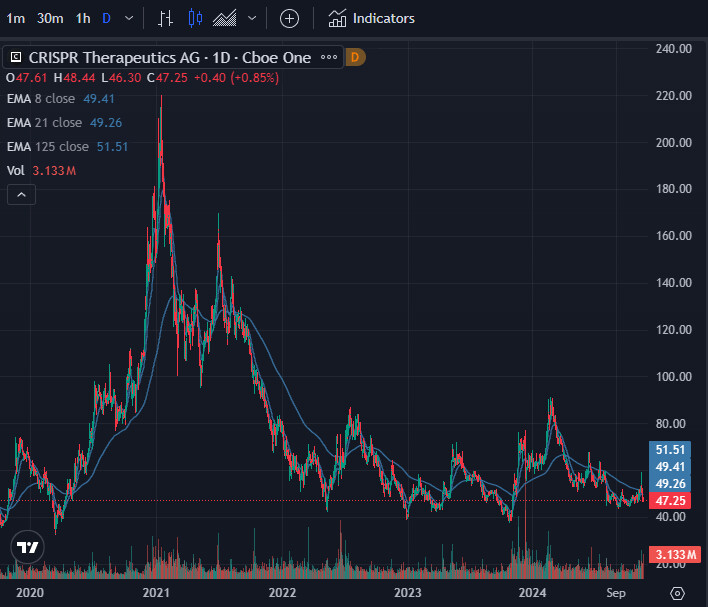
In 2020, CRSP experienced substantial gains, which were erased in 2021. Since then, the stock has traded sideways, forming what technical analysts might consider a base. These periods often precede a potential breakout, provided the company delivers strong financial results to sustain upward momentum.
Market Overview

With a market cap of $4 billion, CRSP would rank comfortably within the ASX 200, as its valuation aligns with mid-to-upper-tier Australian companies. However, in the U.S. biotech sector, it is considered mid-sized. While it is much smaller than industry giants like Amgen or Regeneron, CRSP holds a notable position among innovative biotech firms developing cutting-edge therapies.
Short interest in CRSP exceeds 26%, with 19 days required to cover these positions based on average trading volume. This indicates significant market scepticism about the stock. However, unexpected positive developments could trigger a rapid price increase as short positions are closed.
Current Balance Sheet

CRSP’s tangible value stems primarily from its cash holdings, which are substantial. Often companies that are heavily shorted are low on cash and have significant debt loads suggesting a future capital raise will be needed. That is not the case with this company.
Earnings
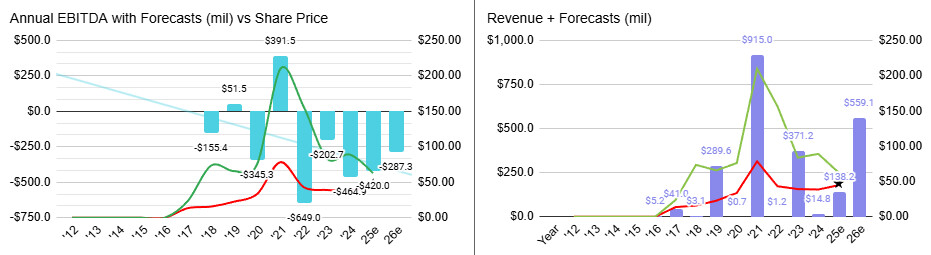

The company’s revenue history is inconsistent, driven by milestone payments from its partner, Vertex Pharmaceuticals. Future revenues are expected to grow strongly as its first approved treatment gains traction. EBITDA is also forecasted to improve significantly.
Valuation

CRSP remains unprofitable, and its valuation at 20x sales appears high. However, the projected revenue growth may justify this multiple over time. Analyst sentiment is broadly positive, with a 12-month average price target of $79.54 from 24 analysts.
Technical Analysis

A look more closely at the recent price action shows that the short-term uptrend that was in place since mid-October has now collapsed back into a downtrend. CRSP has tried to break the downward price momentum on three occasions with the share price pushing above the medium-term trend as indicated by the 125 day EMA only to be rejected every time. It looks like the company will have to consolidate further around the lows before it can try and mount a fourth attempt at changing direction.
News From The Company
On November 11, (which can be seen as the day the share price spiked to almost $60) CRSPR’s CEO sold 30,000 shares. While still owning 196,540 shares, there is no doubt that that has put a serious dampener on what was looking like a promising share price recovery.
On November 5, the company announced their quarterly results beating market expectations with a narrower than expected loss of $1.01 per share. In the same period 12 months ago, they reported a loss of $1.41 per share. Total revenues were negligible though at $0.6M and were entirely from grants.
Vertex Pharmaceuticals (NASDAQ:VRTX)
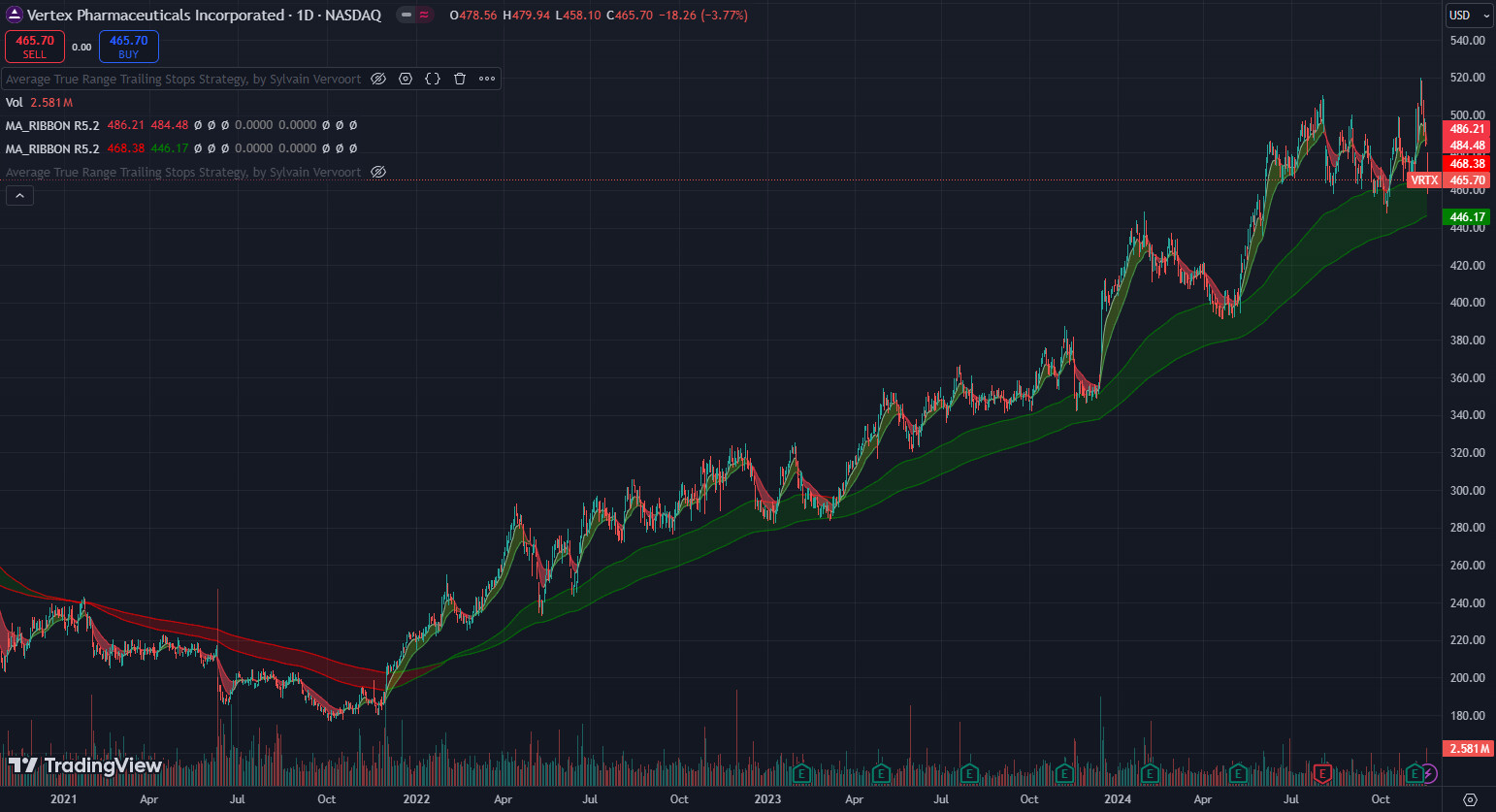
Vertex leads the global commercialization of CRISPR’s gene therapy, Casgevy. They reported $2 million in initial product revenues during their latest earnings release, highlighting a strong launch. For risk-averse investors, Vertex may offer a safer way to gain exposure to CRISPR’s success.
Controversy
- Throughout my analysis, the phrase “controversial therapies” frequently appeared. CRSP operates in gene editing, which raises several concerns:
- Off-Target Effects: Unintended genetic changes may pose health risks.
- Germline Editing: Modifying embryonic genes can affect future generations, sparking ethical debates about “designer babies.”
- Access and Equity: High costs may limit access, worsening healthcare disparities.
- Environmental Impact: Gene editing in organisms might have unpredictable ecological consequences.
- Regulatory Challenges: Global laws on genetic modification vary, complicating compliance and oversight.
Final Thoughts On CRISPR
CRISPR Therapeutics operates at the forefront of biotechnology, leveraging cutting-edge gene-editing technology to address critical medical challenges. Despite its innovative approach and strong financial position, the company faces significant hurdles, including market skepticism, ethical controversies, and inconsistent revenues. CRSP’s future will likely depend on its ability to deliver consistent results, navigate regulatory landscapes, and address public concerns about gene editing’s broader implications. While the company shows potential, its path forward remains contingent on balancing these challenges with its technological promise.
Disclaimer: This information is provided purely for educational purposes. It takes no account of an individual’s personal financial circumstances and hence can in no way constitute financial advice. The above data may be subject to errors or inconsistencies for which the author takes no liability. It is imperative that all investors do their own research or if they need advice, seek it from a qualified financial adviser.
Crispr NASDAQ:CRSP Analysis
Austal Limited Analyst Call 01/11/24
Austal Limited Analyst Call 01/11/24
Otherwise, click HERE for a 10 point summary.
John Rothwell
Good afternoon, ladies and gentlemen. They’re probably not all that many people that don’t know me, but my name is John Rothwell, and I’m the founder and the past Chair, I said correctly. So we have — I would like to welcome you all to the 2024 Annual General Meeting at — of Austal. And my role today isn’t — in some ways, it’s fortunate. I’ve been doing this for 25-odd years and I’ve been the head of the company for 37.
So — but we have a new chair, and my role today is to introduce that new Chair. And I will do that in a moment, but I would probably just like to spend a couple of minutes, and that’s about all. We’ve got some pictures of the past 37 years since we started Austal, and it’s been a fun ride. The day is too short for me to start telling too many stories, but it’s been phenomenal.
So 37 years ago, I invited some young guys that had worked with me or for me to listen to my vision of what we could do with Austal. They joined me, and we kicked off back in — set up in ’87, started ship construction in ’88. Now again, most of you know the road that we’ve traveled and started off with ferries for China, then decided that maybe we needed a broader spectrum of work and started to build some patrol boats for the Australian Coast Guard customs-type people. And I guess and some of these, of course, the bigger ferries that you’re seeing now, but we grew through that.
And the highlight for me was, of course, what we finally achieved in the United States back in, let me just try and get this right, about ’97, I was invited to Washington to attend a workshop for — by U.S. Navy to try and determine how they could use high-speed ships for U.S. Navy and the workshop didn’t achieve too much.
But what it did do it convinced me and I was able to convince the other shareholders that we should be in U.S. That, of course, culminated in — we were not security cleared. We had to be a subcontractor to General Dynamics. And we did that in the end, that was when we got our own security clearance, they disappeared and they became a subcontractor to us quite frankly. But that’s the U.S. front.
And in Australia, we continue to build high-speed ferries such as you’re seeing, we opened a shipyard in Cebu and one in Vietnam and continued on with trying to win more defense contracts. And you will have all read recently in the last 12 months or so, where Paddy, our CEO, largely drove the relationship with Strain Defense, and we’re now in a very good position to build war ships, invest in Australia that are going to be built here.
So for me, personally, the highlight was very much the USS Canberra sailing into Sydney. So just think about this we were tasked or we started again. We put our hand up to bid for future little combat ships. And I think that came about largely after the attack on the USS Coal in Yemen, where maybe started to think about agility in literal areas.
And we then had a Trimaran, which you’ve seen some of here, the yellow boats that you saw as a commercial vessel. We then locked about 60 young Australian naval architects up in a secure area for a period of time, and they spent to us for years developing that warship.
So it was to see to think about a total concept by Austal, of which your shareholders or many of you are shareholders to think that, that could turn around and have become — we’ve built something like about 18, 19 of these ships right now. To think that one of them would one day be called USS Canberra and be escorted in through the Sydney head by the HMAS Canberra, it was a phenomenal moment for me. And all our people would have been very, very proud. It was absolutely done by Australians, although built in the United States.
So I’ve gone on long enough. I promised you I would introduce our Chair and many you will have seen Richard Spencer’s name. Richard has a lengthy career in both Navy. Of course, he was the Secretary of Navy in the U.S. the highest position that you can have in maybe in the U.S., to my knowledge. I think that’s right. And so he knows the customer real well, that is our majority customer.
Richard then also spent a lot of time working in finance area, and it was very fortunate that we came across Richard, and he agreed to Chair the Board. From my own perspective, it was something I’ve been thinking about for a couple of years, I turn 80 early this year. And only a few goes on too long, I keep saying, and I certainly didn’t want to be in that space. But I deliberated on what would be the most suitable future tier successor for me.
And again, very fortunate to have come across Richard. So what I’ll do, I’ll vacate this space. I think before I go, just to say that I think Austal’s in a great position, and I don’t want to pat myself on the chest and show, I did all that because it’s a whole bunch of people that did that. And I was fortunately part of it. But Austal’s in a great position when you’ll hear much more about what we’re doing in the U.S. You’ll hear about we’ve come through the aluminum or ships such as that and also a fast freight called EPF. And we’re now, of course, doing steel ships. We’re also doing components or modules for the submarines, the Virginia class submarines and maybe Columbia ones as well later on.
But Austal’s in a great position. I think it will do very well with a new chair. I think we’ve got an excellent team — business team — sorry, the business leaders at Austal under Paddy. And I just feel that it’s set for a great future. I’d like to think that when I do step off the bustle together out of the Board, I would like to be able to sit back there and continue to see Austal prosper and I feel confident that it will.
So there’s one more thing I wanted to do before I move on. Chris Indermaur has been our director for the past 6-plus years. Chris has added a lot of value, and I wanted to personally thank you, Chris, for what you’ve been able to do. So let me shut up and let me put someone far more capable of talking in front of these microphones. Thank you.
Richard Spencer
Thank you, John. You’re not going to get away that easy. But before I say a couple of words on my own folks, let me address some formalities of this meeting, if I could. This is a shareholders meeting and only shareholders, their proxies, attorneys and authorized representatives are entitled to speak at this meeting.
This is a meeting being webcast to shareholders, who are unable to attend in person. As it is a webcast, virtual participants will be able to listen to the meeting live and view the presentation materials, but they will not be able to ask questions, make comments nor vote through the webcast facilities.
I’d like to introduce my nonexecutive directors, who you can see are here before you Sarah Adam-Gedge, who serves as our Deputy Chair and also Chair of the Audit and Risk Committee; Chris Indermaur, who is the Chair of the Board’s Nomination and Remuneration Committee. Chris was up for reelection at this meeting, but has decided not to put himself forward for reelection. His term will, therefore, come to an end at the conclusion of this meeting. I would like to personally thank Chris for his 6 years of service since 2018. Your contributions have been invaluable.
Lee Goddard, who has been on the board since January of 2023. Kath Toohey, who joined us February of this year; Brent Cubis, who joined us in October of this year, and of course, Paddy Gregg, our Chief Executive Officer. Each of our Board members presents — is able to assist in answering your questions as we go forward today.
We also have a representative from the company’s auditors, and external legal advisers present. John, it’s an absolute privilege and honor for me to accept the transfer of reigns from you as Chairman to oversee this great company. Austal’s accomplishments here in Australia and overseas have been absolutely remarkable, and it’s due in no small part to your amazing presence foresight, drive, determination and strategic approach to the Austal business. And this, ladies and gentlemen, I think we give John a good round of applause for what he has done.
Much has been made of Austal’s transition from building aluminum cray boats to the present, occupying a crucial position in the U.S. defense industrial base as the designer and/or builder of warships and nuclear submarine modules for the U.S. Navy and the U.S. Coast Guard.
The company started with just one build program in the U.S., as John referenced, the joint high-speed vessel for the Navy Military Sealift Command. Now it has 12 programs in the United States. And with the expansion of additive manufacturing, which Paddy will get into, it will provide us even a more secure place within the defense industrial base and ultimately provide you the shareholder greater value.
This staggering expansion has been a 36-year journey for Austal with one constant, John Rothwell. I needed to do very little due diligence when I was approached to take the Chairman’s role. I had already had a significant interaction with the company going back to 2017, when I was Secretary of the Navy. I was impressed with its pragmatic approach, its desire to grow and provide solutions to its customers, such as the U.S. Navy, the Royal Australian Navy, U.S. Coast Guard and Australian Border Force.
And I was also taken by the amazing commitment of Austal employees to their respectful — for their respective national security. On the latter point, one thing that struck me when I first visited Austal’s headquarters down in Henderson last July and that was the honor board in the Austal office. And in particular, the staff who had worked at Austal for 10, 20 and 30 years.
The list is incredibly long, ladies and gentlemen. John himself has 30 years, as you well know, another 30 staff members have clocked up 25 years. Another 36 members have clocked 20 years. I see a similar set of boards in Mobile, Alabama. And I note some of the original disciples that came over from Australia have remained there since the doors opened 20 years ago back in 1999.
The longevity of workforce is a testament to the culture of an organization. The number of people who remain with Austal is a testament to Austal itself. Since becoming Chairman, I’ve held initial discussions with some of Austal’s most important stakeholders, whether they are employees, customers, suppliers or shareholders.
The 3 things have stuck with me. First, the can do DNA that permeates the enterprise, whether in Australia or the U.S. and the acknowledgment of that DNA by those stakeholders, particularly our customers. Two, the understanding of continual advancement of modular assembly and industrial flow as it pertains to our business, we are like no other in the defense ecosystem. For those who don’t have the same understanding of industrial flow charts, that translates to the continuing build of ships more efficiently.
Three, the endorsement and appreciation of intellectual curiosity, which can be seen in our center of excellence for additive manufacturing, robotics, advanced materials and the application of evolving technologies. These provide the foundations of our business. And those foundations will support the company’s growth and again, ultimately provide value to you, our shareholders.
I’m not going to spend a lot of time on the financials for the year that just ended because I was appointed post June 30 and can lay no claim to having any influence on the quick turnaround. The quick turnaround $4.8 million earnings before interest and tax loss in fiscal year ’23 to a $56.5 million positive EBIT in 2024. A $28 million turnaround in profit from a loss of $14 million in ’23 to a net profit after tax of $14.9 million in fiscal year ’24.
However, what those figures tell me is that as Austal enters the next chapter of its life, it will with an excellent financial and operational base to support further growth. And our growth strategy for the next phase is very simple, but groundbreaking at the same time. Let me explain why.
Our goal at its core is to be the strategic partner for the Australian and U.S. Navy’s Border Force and Coast Guard. When it comes to maritime products, we will be first of mind. That is our goal. We want to move away from other companies to simply take orders and build ships. We want to be there to solve problems, a disciplined strategic partner.
What do I mean by that? I believe a partnership is where we work together collaboratively with our customer to improve designs to reduce build times, to make the build process more efficient, a partnership where we ultimately understand their drivers and provide solutions to their problems, a partnership where we provide support to their vessels over many years and then put what we learn from sustaining those ships back into future designs, so we continually improve.
It sounds simple, yet no other companies are doing it. So the playing field is wide open for Austal. And we will own this space and entrench ourselves with our customers. Our expansions in the submarine modules and additive manufacturing is an example of this, but it is just the beginning. We have continually invested in Mobile, Alabama, and we probably have the most modern shipyard in the U.S., coupled that with a technology like robotic welding and there’s no one who can touch us.
Expect more from robotics and what we call Industry 4.0 as we build out our submarine module facility in Mobile. This investment helps us improve efficiency, provide cost-effectiveness solutions for our customers, as I addressed earlier.
In the U.S., the planned growth of our campus in Mobile will be a key component of our strategy. And there are some really important points about the planned expansion of Mobile that I’d like to highlight. Firstly, many companies take a considerable build it and hope they will come. This risk is usually undertaken with capital expansion similar to those that we are about to embark on. Austal does not take that risk, because we already have the construction contracts in place to underpin that expansion.
So provided we can efficiently execute. It does not pose the risk that other capital expansion programs pose. Secondly, in some cases, we’re actually being paid to expand with other groups funding the capital cost because of Austal’s importance to the U.S. military industrial base. As an example, the recent announcement of the funding from the U.S. Navy through a contract from General Electric — I beg your pardon, General Dynamics Electric Boat, where electric boat will pay Austal $670 million to build a submarine manufacturing facility is a testament to how Austal is viewed by those in this industry.
Austal’s market capitalization is about $1 billion. Yet there is one of the biggest companies in America, defense companies in America, paying Austal the equivalent of 2/3 of its market cap not to build submarine modules, but to build the facility that will ultimately build those modules. And while we don’t and will not take it for granted, there is no doubt in my mind that this is an enabler and hopefully, a precursor for the future construction contracts on the U.S. nuclear submarine build program.
Additionally, while I have naturally devoted much of this speech to the United States. Austal’s position in Australia defense industrial base is just as important to our strategy. The strategic shipbuilding agreement heads-up agreement signed with the Commonwealth late last year, should position Austal as the Commonwealth preferred shipbuilder for all Tier 2 vessels, such as landing craft medium, landing craft heavy general person — I beg your pardon, general-purpose frigates and optionally crude vessels. This will establish Austal’s position with the American — with Australian defense and provide us build orders for the next 20 years with a considerable backlog to perform more.
Strategic is an overused word. But in this case, it is perfectly apt. The federal government is taking a very strategic approach to its maritime defense requirements. And importantly, Austal and its shareholders that — Austal and shareholders, that strategic view extends to the vessel construction program needed to meet those requirements. If the submarine modular facility and the submarine build in the U.S. is an enabler and a precursor, then I believe the SSA is a similar enabler and precursor in Australia.
And Austal will have that same position as a strategic partner with the Australian Navy. One thing I haven’t mentioned is AUKUS. There’s another ripe opportunity for us to benefit. We are one of the few Australian businesses with significant operations in the United States, and I am certain there will be future opportunities in this space, both in Pillar 1 with submarines and Pillar 2 with some of the technologies I’ve already referenced, which brings us full circle back to John Rothwell, the company he has built and what has been achieved by many, many — and has achieved many, many great things, including those I’ve just listed. And I hope he continues to receive the accolades that he is due. Austal is poised to build on that foundation in the years to come. And that’s what I’m looking forward to as Chairman of the Board on behalf of you, the Austal shareholders. Thank you.
Patrick Gregg
Good afternoon, everybody. So I’m going to build on what both John and Richard have talked about and help you understand just what an exciting point Austal is at. I’ll refer back to some historical information to help frame where we were 3-or-so years ago. And hopefully, that will you understand just what a great situation we’re in today. And I’ll fast forward a bit and help you understand some of the announcements we’ve made and what that’s going to look like for the future. And then because we built some very cool stuff, we’ll have a lovely video at the end to, again, show products that are actually happening.
So if I think about the situation we’re in at a minute, we’ve cleared or we’re clearing the slipway we’re ready for launch. We’ve had 3 pretty tough years, a lot of issues to deal with. And I think we’ve got through the vast majority of that. And the business is absolutely primed and ready for growth. In the last year, we delivered our EBIT guidance, pretty much bang on the middle of the range that we gave. And today, we’ll be giving more EBIT guidance for this year. Big issue that was overhanging us. We resolved the Department of Justice matter, and that really has freed us up to look towards the future, an issue that happened back in 2015, and we spent 4 years working on, having got that behind us really opens up in the future.
And as both John and Richard have talked about, relationships to the customer are vitally important. The whole team have worked incredibly hard in the United States and in Australia to build that relationship and to become a trusted partner. We are really committed to delivering on our commitments, and I think that’s really been recognized, and we’re in great shape today. So if we look back 3 years, we were probably stood here talking about what does Austal look like after LCS ends? That was the big question. You built 2 programs in the United States. One of them is going to end, what are you going to do? Is this the end? What does it look like? So I can now tell you around 13 programs in the United States. We’re working with Navy. We’re working with Coast Guard. We’re working in aluminum. We’re working in steel. We’re working in ships. We’re working in submarines.
It’s been a phenomenally hard 3 years and the diversity we now have in the business puts us in a really great place for long-term growth. That steel investment happened and we opened the facility back in 2022. It’s really hitting its stride now on some of the technology and the automation and the robotic welding we’ve got in there, this is a world-class shipbuilding absolutely at its best.
Submarine modules and the manufacturing facility. I’m going to show you pictures of that and help you understand what it is. But yes, helping people understand that, that $450 million announcement is to increase our facilities. We will then have those facilities for many, many years of revenue to go through the business. San Diego drydock, it is now in San Diego, and we’re working through this year to commission it. So again, another area of growth, not just shipbuilding, we set a target few years ago to get to $500 million of revenue by FY ’27.
You’ll see in the pictures of that dock and how that is going to enable us to hit those targets and indeed exceed them. And then thinking back here, 3 years ago, we were building the 13th Guardian. We’re now on the 21st or just delivered the 21st Guardian on the 11th Evolved Cape,and we’re now on 18th and appointed as the strategic shipbuilder in Western Australia, something that we could have only ever dreamed of, really.
For years, we’ve talked about the need for continuous naval shipbuilding, the efficiency and the certainty that we’ll put into the business and the employees. Whenever the government came out last November and announced us as a strategic shipbuilder, really put us into a new league and really paved the way for a long bright future. So we’ve put a lot of work into creating long-term value for our shareholders. The strategic growth opportunities, the order book that sits at $12.7 billion today, excluding everything that’s coming in Australia. That is probably the best part of $20-plus billion over 20 years.
So these are numbers we could never talk about. Business diversity and reducing risk. Whenever we had 2 programs, if we had a problem on one program, it just marked its way through the results and made shareholders pretty unhappy. That diversity of workload hopefully, when somebody is having a good day and somebody is having a bad day, we can actually still carry on delivering stable results as a business.
Lots of programs that we’ve won. We are moving from this transition phase and we’re now into the execution phase. So we’ve won the work. That’s arguably the hard bit. Whenever it’s execution, it’s much more in our control. Huge investments coming, whether that’s submarine modules or the land next door. And again, I’ll show you that on pictures. And I still think, even though we’ve had a great run in the share price in the last couple of weeks, whenever you look at how big this business is going to be in years to come, there’s still opportunity for share price growth.
So comparing some of this year’s stats to 3 years ago, some of these will help explain the situation we were entering. Ships ordered one back in 2021. So we were coming off a peak and we were entering a bit of a trough as we transitioned from the old LCS EPF programs into what’s new? This year, 13 ships ordered. So we are growing. There is more coming.
Ships under construction. That order book is there, and we’ve got the runway ahead of us. Ships delivered. Look at that record a year or 3 years ago, 19 ships delivered in a year, only 7 ships delivered this year. That gives me the confidence that we are back on the way up and look at what we have delivered in the past.
We know how to do this. Execution is what we do very well. We are ready for it. Ships under sustainment, recognizing sustainment a great part of our business, having delivered all those ships over the last few years. Lots more work and growth in the sustainment world. Service centers and shipyards very similar to where we were 4 years ago, but investment in those and making them ready for growth is what we focused on.
As the workload dropped off, the employees dropped off, but look at where we have been, we probably need 3,000 employees globally right now, 2,000 in the U.S., 1,000 in Australia as these programs come on board. We’ve run a bigger business. We know how we will do it. It’s not going to be easy, but we need to go out and win those people back and grow the revenue. And then the order book, very, very pleasing figure. Tendering is a difficult thing. Winning is even harder.
We’ve got that order book, and we’re not ready for delivery and execution. And again, revenue falling as the order book dropped off and ready to grow as we recruit people going forward. And what does that look like in pictures, I could have put 3 pictures up there 3 years ago. And here we are with some amazing opportunities.
Nuclear submarines would never have been on there. Nuclear submarine is probably a Navy’s greatest asset and something that will go for a very, very long time. So getting into that program is a tremendous opportunity for us. Top right, you see the Coast Guard also diversifying our customer base, working with the U.S. Coast Guard and the same way we work with the Australian Border Force building ships in steel and aluminum, they attach ship right in the middle, the first deal ship that we’re working through an incredibly big and complex ship.
And then looking forward to the future, whether it’s medium landing craft, heavy landing craft and the general-purpose frigate that the government have all announced great opportunities for Austal to go and get after. And then also really pleasing, 2 tremendous shipyards in the Philippines and Vietnam.
A few years ago, we moved our commercial work to those countries, so we could still be internationally competitive and it was really tough during COVID. People did not want to spend $100 million on a new boat whenever they were unsure as to whether they could get the revenue back on that.
Well, that’s changing. We have won 3 orders, and there are more in the pipeline. So we will see the Philippines and Vietnam continue to grow as we go forward. So pretty much exciting and great opportunities right across the business everywhere I look right now.
So some of the financial highlights. These were the year-end results. So as Richard talked about, last year was a tough year or the year before it was a tough year. We had the onerous contract with T-ATS, and that didn’t do us any favors. But having turned the corner coming back up, delivering $56.5 million of EBIT. We’ll talk about guidance soon. We spent a lot of money investing in the business, which had taken the cash down. We had an onerous contract, which serves our cash. But I’ve put the current cash figures in this presentation. That $450 million we got in the United States is a very front-ended load — front-end loaded cash positive contract, yes.
So right now in the bank account $396 million. We’ve gone from worrying about things are getting tight. We’ve got an onerous contract to our CFO, Christian worrying about what interest rate he can get on the cash we’ve got deposited in the bank.
So a big turnaround for us. It’s taken a bit of pressure off the immediate need for CapEx for final assembly too that we’ve been talking about for the last 18 months or 2 years. But again, we’ve got some good news on that on our way forward. So I’m pleased with where the financials are and where we’re going, and we should have turned that corner and just continue to grow.
What are these ships that we’ve looked at do in terms of bill generations and dates. If you’re a financial analyst and you want to go and build a model, this is absolutely in there to help you put your numbers in the right years. But for me, when I look at this, I look at the top and programs that are going on past 2034. So that longevity, that certainty we’re putting into the business allows us to attract people, train them, retain them with the work that we’ve got and really just continue to grow that business.
So you see what that looks like in the United States, and we’ve done the same thing with the Australian pipeline as well. Some of these things on contract and then down the bottom end of the slide, some of these opportunities. But again, look at the time lines. Historically, we’ve stood here and talked about, we can see 18 months look ahead. And having we done a great job keeping that going for 37 years, but winning some of these progress that put 10 years of certainty in the business is a very, very exciting place to be.
So what does that look like in terms of numbers, investment proposition? Share price has recovered recently, Fantastic. I think that’s where we closed last night. You’ll see from the EBIT, we had the disaster in FY ’23 with the onerous contract. You can see that turning a corner, and you can see that continuing to grow into the future. Order book absolutely stand out and puts the certainty in the business. And then that revenue growth, a representative line in there of how the revenue is going to grow in line with the programs that we’ve already won and what’s been announced to come in Australia.
So I think from an investment perspective, also still a great opportunity. So guidance, whenever we did full year results, we promised we put our guidance at the AGM, and here we are. So we’re guiding to an EBIT of $80 million this year. So you can see an increase again on last year. Consistent as we continue to get into the execution phase of these contracts. We’re optimistic that we’ll continue to grow the EBIT back to where it has been and indeed straight through that and years and years of growth ahead of us.
There’s always some complications in terms of the levers we’re pulling, what we’re wrestling with to try and pin the tail on the donkey and give you an exact number. And we’ve put some of those up there just to help you understand some of the things that we’re dealing with on a daily basis to try and make sure that we can manage the risks and the opportunities and come out and hit our numbers and keep everybody happy.
But I think that’s a number that’s very much in line with analyst estimates. And I think it should be well received today that we’re confident that we can deliver in line with it. So let’s have a bit of a run through some of the things that are going on in the business. I’m not going to go through every project, but I want to talk about things that are strategically important.
Yes. So in Australia, we are very committed to partnering with the Commonwealth with Navy, with Border Force. We’ve had an amazing track record of what we’ve delivered in the last few years, even during COVID, we kept the shipyard open. We continued delivering ships, and you look at the number of ships that are out there, there was very much a theme of Austal deliveries on time and on budget we can be relied upon by our customers. So really amazing delivery schedule from the guys here in Australia and also working with a whole lot of Australian partners in the supply chain.
Us winning a prime contract is great for a lot of people outside Austal. If we look at what’s happening in the U.S., so there have been a lot of announcements recently, and I wanted to put this in here just to try and help you understand exactly what’s happening. So if I use the pointer, this is kind of the existing shipyard as it is today. That’s the steel facility that we built a couple of years ago. So we cut metal here and we run down a production line, where modules, big sections of ship come out. They go to the completion sheds, final assembly sheds where the modules are joined together, turned into ships and we launch them out the front into the river, take them around to the vessel completion yard where we commission them and take them out into the Gulf of Mexico on sea trials.
So 2 announcements recently. We have been talking about final assembly 2. So this is all fine for aluminum ships, which are considerably lighter than steel. Steel obviously being 3x as dense as aluminum, it all weighs a lot more. And you’ll notice that the interstate disappears. Well, actually, it goes through a tunnel here under the river. And the tunnel can’t take the load of the major modules that we want to bring in. So we need a new vessel completion site for steel ships. We need heavier floor loading. We need bigger cranage.
And we actually want to build a ship lift out the front. So we can either launch ships or if we want to do maintenance on ships, we’ve got the ability to bring them up and do work on the ships. These are the 3 sheds that we want to build. And those are big enough for everything we foresee in the future. So not just the work we’ve won today, like the offshore patrol cutter or the T-AGOS surveillance vessel. Those will be big enough for frigate if they want to go for a second source or some of the bigger logistics ships that we see coming in the future.
So tremendous opportunity for us and a very exciting time that we’ve received a letter of support from an Australian government financing agency and for up to 50% of that $300 million, that should help us underpin the rest of the lending syndicate to allow us to come out in the near future and finalize exactly how we’re going to fund the building of that facility. So the other announcements that came a couple of weeks ago, again, very exciting. 2 module — 2 announcements back to back. One of them was the USD 450 million. So a piece of land that we bought a year ago, 2 years ago, in preparation for this.
This has been an awful lot of work in progress for our teams to try and secure this but a big purpose-built module facility that could build up to 20 submarine modules at any time. We will probably have 1,000 people working in that building, and you guys can do the calculations on revenue versus people, but that will be in the hundreds of millions of dollars of revenue that we add to the business going forward.
And that has been backed up with commitment from Electric Boat to put the work to us. And then the second announcement was around the submarine industrial based investment in the Alabama shipyard that was next door to us. The Navy have invested through us into a fund that has bought that shipyard with a view that they would like to develop it and it provides a great opportunity for future expansion and growth. Again, we’re not going to win or lose on that through the financial system, but it gives us first run of refusal on opportunities for the future. So Navy really backing us again to say, hey, we think you’re going places when you run out of space in a few years’ time, we’ve already secured the facility that you’re going to grow into.
So a very, very exciting opportunity. And I hope that helps to explain what the site’s going to look like in Mobile, Alabama in the next couple of years. Support business, I talked about. You can see the trend graph that we’re on track to hit our $500 million, maybe slightly ahead of it. Real focus to get the floating dock, which is a huge dock that we had built and delivered to San Diego. We’re now working with the various agencies, environmental agencies to make sure we can commission that dock and really take a big step forward in terms of the revenue we can generate in San Diego.
But recognizing we do this in other places as well, whether it’s supporting the U.S. Navy out of Singapore, whether it’s supporting Trinidad for the Capes and ferry that we delivered a few years ago or whether it’s here in Australia with the yards in Brisbane cans and Darwin, and that growing number of patrol boats being delivered, that will be stationed out in Cairns in the future, support is very much a great part of our business and one that has opportunity for growth as well.
So a few years ago, we talked about submarine modules and people kind of scratched their heads and said, what’s that? What can that be for the business? We spent the last 2 years working very hard on that. And hopefully now, we’ve been able to communicate just how lucrative that’s going to be and what a great deal that is for Austal.
Well, in the United States, we’ve been funded to set up an additive manufacturing center of excellence that Richard talked about in his speech. That is really going to support the U.S. Navy and their desire to get parts that are a traditionally forged a cast, built in a much more modern, much more reliable, much quicker fashion. And Austal’s right at the center of it. So we manage that facility.
We understand the IP. Arguably, we’re learning the recipes of multiple materials that are cold spread or additive manufactured or laser cut, their properties and the heat treatment. And every day, we’re delivering more and more components. We’ve delivered over 100 components — now 100 different components as part of this program to start delivering for the United States Navy.
Richard talked about AUKUS and Pillar 2 of AUKUS, which is more focused on the technology and things like that. I think this is a prime example of AUKUS in action. We’ve been funded by the United States Navy. We’re doing the development work. We’re proving the products. That is very easy for us to replicate that capability here in Australia. And imagine if the United States Navy needed a part for a U.S. submarine that is under maintenance here in Paris as per Richard Marles’ announcement last week and the submarine maintenance coming.
While someone in Austal can receive an order in the United States, press a button, send the recipe down the tube that pops out on a 3D printing machine right here, and we can walk out the door and deliver the part to the United States Navy. So just a bit of a teaser to get you excited about what the future looks like and where we’re going, but another great opportunity that I wanted to talk about. And I’ll link that with things autonomy. So in the U.S., we’ve still delivered the largest autonomous ship in the U.S. Navy, the EPF 13. And here in Australia, we took the patrol boat autonomous or sentinel, as we call it, the old Armadale that we bought, converted, it was able to drive itself to Geraldton and being controlled right out of the Henderson office. And we’ll have a little look at a video on that later on.
But that’s got to be a good opportunity for the future. And this is Austal demonstrating whether it’s United States or whether it’s Australia. We are autonomous capable. We understand the technology and we can absolutely do it. So I think we’re doing a good job at focusing on what we’ve got to deliver today and execute the contracts we’ve got.
And we’ve got half an eye in the future about where all the growth is going to come from. So if I talk about — just to summarize things as I see it, as we’ve gone through, the record order book in the U.S. and what’s coming in Australia puts us in a great place. Positive momentum with the announcement on the Henderson precinct. I’m pretty pleased that the government while it was frustrating for a while, we did a defense strategic review, and that took a bit longer and then we weren’t certain on the output and then we did a fleet review.
Well, to be fair, and they said, this is what we’re going to do. And every announcement is consistent with they said they’re going to do. So in my mind, they are delivering on their commitments and long may it continue because we’ve had many years of uncertainty, and this is putting a whole lot of certainty into the system very, very exciting time. And our underlying business is performing pretty well. You can see that from the numbers, the growth in the EBIT. Still a couple of challenges out there.
We want to finalize the funding for the facilities in the U.S. that we’re going to invest in. We’ve still got the T-ATS program that we talked about last year. We need to resolve that with Navy. Great conversations happening. And I think based on how supportive they’ve been of Austal generally, it’s hard to imagine they’re going to stiff us on T-ATS issue.
So we’ll continue to work with that and do everything we can to get that resolved this year. The growth in Australasia, very exciting with the strategic shipbuilding agreement, the commercial orders that we’ve looked at. Support business going really well towards its targets and the floating dock there. The CapEx that’s happening, whether it’s funded by U.S. Navy, whether it’s funded by Austal, but we are setting that yard up to be probably the most modern, the best equipped shipyard in the United States, really, really exciting time.
We’re in that transition and the growth of people is going to be pretty exciting. It’s great that we’ll be able to grow both in the U.S. and here and provide longevity of jobs and revenue for the company. Still more opportunities. We talked about AUKUS, I’ve given you some examples through additive manufacturing, through autonomy. I think we’re only scratching the surface of AUKUS at the minute. The focus is still very much on the submarines and how they’re going to get those.
But the whole Pillar 2 side of AUKUS, I think Austal’s really well placed to try and grab that. Relationships are critically important. Whether it’s through tendering processes, whether it’s with customers that we’re building boats for, whether it’s boats in service, we are working very hard to build that relationship and be a reliable partner for the very long time.
And I think my summary is we have come through the last 3 years of transition, and we’re into the execution and growth phase. So very, very exciting time from my perspective. and I will leave you with a video showing you the autonomous patrol boat.
[Presentation]
Richard Spencer
Thank you, Paddy, for your comments. Truly is amazing. And I think what you’re witnessing here is just the tip of the iceberg. I now welcome any questions from the shareholders present relating to Paddy’s presentation, and so that everyone may hear you, could you please stand and we’ll deliver you microphone, state your name and ask your question.
Unknown Shareholder
I’ve got some queries and I really feel as if I’m — I’ll introduce myself. My name is Ann Pryor, and I’m a very long-term shareholder. I feel as if I’m going to stand here and rein on Paddy’s parade. There were some items in the financial statements that I really didn’t like and are red flags. So I’m going to put them out there. And through you, Mr. Chairman, ask somebody in finance to respond.
First of all, you were cash flow negative from operating activities, which is always a big red flag for me. Secondly, your trade and other payables were up by 88%, which could be explained. However, I’ll leave that to Mr. Greg. And I noticed that there’s a revolving credit facility that’s crept on to the balance sheet of nearly $40 million. And when I look to the further down, the trade and other receivables are up, and I think that nearly double from the previous year. The loss allowance is up by a factor of about 6x. I know it’s only a relatively small amount, but the trend is not a good look. That leads me to wonder if there’s a cash squeeze.
Richard Spencer
That’s very astute analysis. Paddy, would you like to address?
Patrick Gregg
Sure, sure. Thanks, guys. I’ll give it a go. And if I get it wrong, Christian will correct me. But I think they’re all really related to the same problem, and that’s the onerous contract on T-ATS. So we disclosed that to the market. While that contract remains onerous, it eats a lot of cash. So yes, a lot of the other programs generating great cash. But while our estimates are complete or in excess of the contract value, then we’re unable to claim that cash back from the United States Navy. And that’s all part of that request for accrual adjustment process that we are working with them at the minute to recover.
So that has a knock on to cash flow and how we’re paying our suppliers. So whereas we might have been very, very prompt in paying suppliers whenever we had a lot of cash. When we don’t have a lot of cash, we go and manage it appropriately. And I don’t mean we don’t pay people. I mean we might take the full length of time to pay them that we possibly can. And that gets compounded by the growing business.
So you see that the trade creditors and debtors, those things grow as the business is growing. So there is a relationship there that you can add those 2 things together and come up with an answer that says we have a cash problem. The only cash problem is the fact that we are funding the build of the T-ATS program in the United States at the minute. And that will change. I’m confident we will with fix that with the United States Navy.
And then if you want to consider the $450 million that we were awarded for the module manufacturing facility. It’s very convenient that, that is very front-end loaded in cash. And you saw the cash balance today as $396 million. So there absolutely is no cash issue in the business. We do need to resolve T-ATS. I think if you looked at the position with the supply chain at the minute, it is significantly improved on where it was at half year because we wanted to bring those supplier payments back in line with how we’ve done it traditionally rather than take it to the maximum we can.
And we put that focus on the smaller suppliers rather than the bigger suppliers because we know cash flow turnover is harder for those guys. So there’s a huge amount of work that goes on behind the scenes to make sure we manage cash in the business appropriately. But I’m not sat here with a concern that we’ve got a cash issue as a business.
Unknown Shareholder
My name is Neil. I actually have a request for the Board. Can you consider engaging the corporate communications specialist to take over communication for Austal. The reason for asking for that is, if you look at things like your website, it’s not a good look. It’s not professional. The presentation that we’ve just been through, if you look at that, it’s not a great presentation. There’s just lots and lots of words. People sitting here can’t read it. When you do announcements to the market, you are inconsistent in when you use price-sensitive announcements. So there’s been some discussion today about the fact that you’ve had issues with forward order books, particularly when the Asian expansion was underway.
And you think that when the announcements were made to the market, if you have been awarded a contract, you’d make it price sensitive. You don’t always do that. As you build the order book, you think you would be using that market announcement to say, “Hey, this is a contract we’ve got. But this is what it looks like now in Vietnam. And I’m just not seeing it. And I think you’re over burdening Paddy with too much to do, and you need was actually good at corporate communications to present the company more effectively in the marketplace. I think what’s happening at the moments hurting shareholders.
Patrick Gregg
Duly noted. Duly noted. We will take it for consideration.
John Campbell
Chairman, John Campbell. I’m representing the Australian Shareholders Association. I’ve got a question for you. As Chairman of Austal, you’re an American, presumably without a great deal of background in Australian corporate law. You’re located in the U.S. And I don’t know whether you’re located in Mobile, but quite probably not. And I just wonder how you managed to keep on top of things here at Henderson and around the globe? And also whether you’re briefed and requirements of corporate management in Australia?
Richard Spencer
Certainly. I spent 19 years on Wall Street as a banker, dealing with corporate law with great regularity. I’ve sat on 3 public boards, 1 New York Stock Exchange listed board. The fundamentals of law between Australia and the U.S. on the corporate basis are not that terribly different. When it comes to the regulations on the exchanges, I have my corporate attorney — my council here who was giving me tutelage on ASX regulations with the regularity after this meeting, so I feel fairly comfortable that I truly understand what is going on in the regulatory side over here.
John Campbell
Can I ask another one? The settlement you’ve done with the Department of Justice and the Securities and Exchange Commission was to set up a fund, I think, for shareholders to make claims with respect to losses that were incurred because of the misreporting back in the 2013, ’15 period, whatever it was. Do you know how Australian shareholders are going to be able to access that? Is there a mechanism in place whereby they can line up to make a claim?
Richard Spencer
That’s a very timely question. We believe this has been done before. So it is under construction as we speak. Out of our control, but that’s going to be the SEC DOJ probably in concert with the regulatory — regulators here.
If there are no further questions, we’ll move on. I now move to the next item on the agenda, which is the directors’ report and the financial statements of the company. The annual financial statements of the company for the year ended 30 June 2024, together with the director’s report and the auditor’s report in respect of those documents were released on the ASX on 30 August 2024 and were sent to shareholders who so requested. We also have copies of these at the meeting, should any shareholder require a copy. There is no voting on this item of business. Instead, shareholders have the opportunity to ask questions about these reports. Are there any questions from the floor, from the shareholders? There being no question, we’ll proceed — sorry.
Unknown Shareholder
Sorry. Just in relation to your sustainability report, we noticed it comes out some weeks after the annual report. We prefer representing retailers to shareholders. And we have the opportunity to review that at the same time as we review the annual report because the two things are linked in, in terms of investors’ perceptions about their investment and continuing with it. So we’d ask if it’s possible that the publication of the two documents is synonymous at the same time.
Richard Spencer
Duly noted, and I think you’ll see corrections next year. Any further questions? All resolutions will be put to a poll. However, there will be an opportunity to ask questions relating to each of the resolutions I’m going to go through before the poll is taken. Resolution #1 is for the adoption of the remuneration report. The resolution is set out on the screen next to me, and I’ll give you a moment to read it. I note that a vote on this resolution is not binding on the company. The proxies shown on the slide beside me have been received in respect of the resolution. Although I’m personally excluded from voting on this resolution, I will vote the undirected proxies I hold in favor of the resolution.
Are there any questions relating to this resolution? Thank you. As mentioned, we’ll proceed to a poll on all resolutions. I will ask a representative from the company’s share registry to conduct the poll at the end of the meeting after all resolutions have been considered.
We will now move to Resolution 2. Resolution 2 concerns the election of Kathryn Toohey as a director. The resolution is set out on the screen next to me, and I’ll give you a chance to read it. I and the rest of the Board recommend Kathryn’s election as a Director of Austal. I will vote the undirected proxies in favor of this resolution. Are there any questions on the resolution? Thank you.
Resolution #3 concerns my own election, and therefore, I’ll hand it over to Paddy Gregg to chair the meeting for this item.
Patrick Gregg
The resolution is set out on the screen next to me, and I’ll give you a chance to read it. I and rest of the Board recommend Richard’s election as a director of Austal. I will vote the undirected proxies in favor of the resolution. Are there any questions relating to the resolution? Thank you. I will hand back to Richard as we now move to Resolution 4.
Richard Spencer
Thank you, Paddy. Resolution 4 concerns the election of Brent Cubis as a director. The resolution is set out on the screen next to me. I and the rest of the Board recommend Brent’s reelection as a Director of Austal. I will vote the undirected proxies in favor of the resolution. Are there any questions related to this resolution? Thank you.
We’ll now move to Resolution 5. Resolutions 5, 6, 7 and 8 deal with the issue of share rights to some of the nonexecutive directors of Austal. At the last 4 annual general meetings, shareholders approved the grants of share rights to nonexecutive directors so that participating directors will be remunerated through a combination of 75% cash and 25% share rights. Resolutions 5, 6, 7 and 8 seeks shareholder approvals to continue the grant of share rights for 12 months following this Annual General Meeting.
Resolution 5 concerns the approval of the issue of shares to Lee Goddard. I and the rest of the Board recommend the approval of the share rights. I will vote the undirected proxies in favor of the resolution. Are there any questions relating to this resolution? Thank you.
Now we’ll move to Resolution 6. Six concerns the approval of the issue of share rights to Kathryn Toohey. I and the rest of the Board recommend the approval of issues of share rights to Kath. I will vote the undirected proxies in favor of the resolution. Are there any questions? Thank you.
We’ll now move to Resolution #7. Resolution 7 concerns the approval of the issue of share rights to Brent Cubis. I and the rest of the Board recommend the approval of the issues of share rights to Brent. I will vote the undirected proxies in favor of the resolution. Are there any questions related to this resolution? Thank you.
We’ll now move to Resolution 8. Resolution 8 concerns the approval of share — issue of share rights to Sarah Adam-Gedge. I and the rest of the Board recommend the approval of the issue of share rights to Sarah. I will vote the undirected proxies in favor of the resolution. Are there any questions as it relates to this resolution? Thank you.
We’ll now move to resolution 9. Resolution 9 concerns the approval to issue LTI rights Mr. Patrick Gregg. The resolution is set out on the screen next to me. I and the rest of the Board recommend voting in favor of the resolution. I will vote the undirected proxies in favor of the resolution. Are there any questions relating to this resolution? Thank you.
We’ll now move to Resolution 10. Resolution 10 concerns the approval to issue STI rights to Mr. Patrick Gregg. The resolution is set out on the screen next to me. I and the rest of the Board recommend voting in favor of the resolution. I will vote the undirected proxies in favor of the resolution. Are there any questions relating to this resolution? Thank you.
I now direct that the poll will be held in relation to each of the resolutions. Lindell Weston from Link Market Services Limited, Austal’s share registry provider, will conduct the poll. I retain the right to make all final decisions on who may vote. The votes cast and the declaration of the results of the poll. I ask Lindell to come forward to announce the directions in relation to the conduct of the poll procedure.
Unknown Attendee
Thank you. The persons entitled to vote on this poll are all shareholders, representatives and attorneys of shareholders and proxy holders who hold yellow voting cards. If you are here in more than one of those capacities, you will have been issued with as many yellow voting cards as you have separate capacities. On this card, you will find a series of boxes for voting. Please indicate on your card how you wish to vote by ticking or marking the appropriate square for all resolutions 1 through 10. You must mark either for or against for your vote to count. If you wish to cast some of your votes for the resolution and some of your votes against the resolution, write the amount of shares in each box.
The sum of votes cast for or against the resolution must not exceed your voting entitlement. If you are a proxy holder, a summary of the votes to which you are entitled has been provided with the yellow voting card. If you only have directed votes, you need to do nothing other than submit the voting card. Votes at your discretion are open votes as shown in the column titled Votes Open on your proxy summary and can be cast at your discretion by marking either the for or against box. Once you’ve finished marking your card, please place it in one of the ballot boxes circulating the room. If there are any aspects regarding the voting on which you are uncertain, please do not hesitate to ask the Link staff who will be circulating the room. Have — sorry, I got that Paddy. I’ll hand back to you.
[Voting]
Richard Spencer
I believe that those persons who wish to vote in the poll have now done so. If there’s anyone present who has not yet had their completed paper or ballot collected by Link, please raise your hand. If all persons have now voted, I declare the poll closed. I do not intend to keep the meeting open while the poll results are collected. The results of the poll will be announced to the ASX as required. There being no further business, I now declare the meeting closed, and thank you for your attendance. I’d also like to invite you all to join us for tea and refreshments in the back here, and also been advised that we must vacate the presence of the property by 5:00 p.m. Thank you all very much for participating.
Nuix Analyst Call 13/11/24
Neuren Pharmaceuticals (ASX:NEU) Analysis
This is a restricted members post.
How I use stocksunderthehood.com
Introduction
StocksUnderTheHood.com has evolved significantly in its first 18 months. What began as a personal tool has grown into a platform that helps both me and a growing number of others navigate the market more efficiently. As my web and coding skills have improved, I’ve focused on automating key market tasks—far exceeding my initial expectations. Here’s how I now use the site.
Before The Market Opens
Each day, I update the Macro and Detailed Macro pages to reflect key developments from the past 24 hours. This helps me (and others) stay ahead of:
-
Global market moves
-
Commodity trends
-
Signals from Bitcoin and the VIX (Volatility Index)
-
Notable overnight price action
While I’m primarily a bottom-up investor, macro signals still matter. For instance, if bond yields are rising when they shouldn’t, I might hold off on new positions.
I then check for significant company announcements in CommSec, especially for stocks I track. If needed, I’ll refer to their Fact Sheets on my site for a quick refresher.
Fact Sheets

I track around 500 tickers, aiming to present key data in a concise format with minimal manual effort. Thanks to ongoing improvements in my coding, this is becoming increasingly automated.
Here’s how I use the Fact Sheets:
- Company Size
Indicates potential index inclusion/exclusion, which can affect buying/selling pressure. - Free Float & Free Float Value
Helps assess index relevance (based on float value, not market cap) and insider/institutional ownership. - Debt vs. Cash
I prefer cash-rich companies, but will accept debt if it’s justifiable and manageable. - Rule of 40
I prefer cash-rich companies, but will accept debt if it’s justifiable and manageable. - Short Positions
I examine short positions in the company as a gauge of sentiment and risk. - 3EMA Status
A quick trend snapshot. I avoid stocks with a Negative 3EMA. - Dividends
Not a priority for me, but I still check ex-dividend status
Chart Analysis
I review each stock’s price relative to its 3 EMAs and note any unusual volume activity.
I also examine the 12-month short position chart and overlay it with the price chart to see if there’s a correlation. A rising short interest alongside falling prices can flag trend reversals—both in and out.
Premium Company Data

This section dives deeper into financials:
Are revenues and earnings growing? How does the current valuation compare historically? This data often drives investment decisions.

In The Evening
At around 7 PM, the site auto-generates a suite of reports. My routine includes:
- Volume Spikes – Identify high-volume movers; potential trend starters or enders.
- 52 Week Highs / Lows – I scan for new highs (especially those I don’t yet own) to fuel my trend-following approach.
- 3EMA Change Report – Shows which stocks have flipped trends—ideal for identifying fresh setups.
- Heatmap Report – Offers a sector-wide snapshot of daily movement across the 200 largest ASX stocks.
- Model Portfolios – I monitor entries/exits as signals for my own portfolio.
- Short Position Movers – Which stocks are seeing the biggest increase / decrease in short selling activities?
- 3EMA Compliance Report – Reveals which companies are trending up, down, or mixed.
If anything stands out, I dig deeper via the Fact Sheet.
Conclusion
StocksUnderTheHood.com has become an essential part of my market workflow, streamlining analysis and sharpening decision-making. As I continue to refine its tools and expand its features, I aim to make it a go-to destination for investors seeking a data-driven, tactical edge—whether they’re focused on trends, macro insights, or sector-specific strategies.
Disclaimer: This information is provided purely for educational purposes. It takes no account of an individual’s personal financial circumstances and hence can in no way constitute financial advice. The above data may be subject to errors or inconsistencies for which the author takes no liability. It is imperative that all investors do their own research or if they need advice, seek it from a qualified financial adviser.
How I use stocksunderthehood.com
QUALITY Model Update 7
This is a restricted members post.
3EMA Trading Strategy
A trend trading strategy known as the 3EMA Trading Strategy forms the basis for the moving averages employed on the charts in the Fact Sheets section and throughout this website. EMA stands for “Exponential Moving Average”. EMAs provide a way to smooth out price movements and provide us with a trend-line that is a bit more responsive than a standard moving average.
For a list of the current 3EMA Status of nearly 500 companies on the ASX click HERE.
How the 3EMA Trading Strategy Works
- 10-day EMA (fast EMA): This is the most sensitive and shortest-term EMA in this setup, helping to capture recent price movements quickly.
- 21-day EMA (medium EMA): The intermediate EMA acts as a smoother trend indicator and helps confirm the direction that the fast EMA signals.
- 125-day EMA (slow EMA): This long-term EMA provides a baseline trend that represents the broader, more stable direction of the market.
Bullish Signal: A buy signal appears when the 10-day EMA crosses above both the 21-day and 125-day EMAs. This crossover suggests that the shorter-term trend aligns with bullish momentum in the medium and long term.
Bearish Signal: A sell signal occurs when the 10-day EMA crosses below the 21-day and/or 125-day EMAs. The choice of which EMA(s) to follow depends on the trader’s desired risk level for stop-loss.
Confirmation with Volume: Some traders look for increased volume during crossover events as a sign of stronger conviction in the move. This is not essential though.
Some Examples
Megaport ASX:MP1
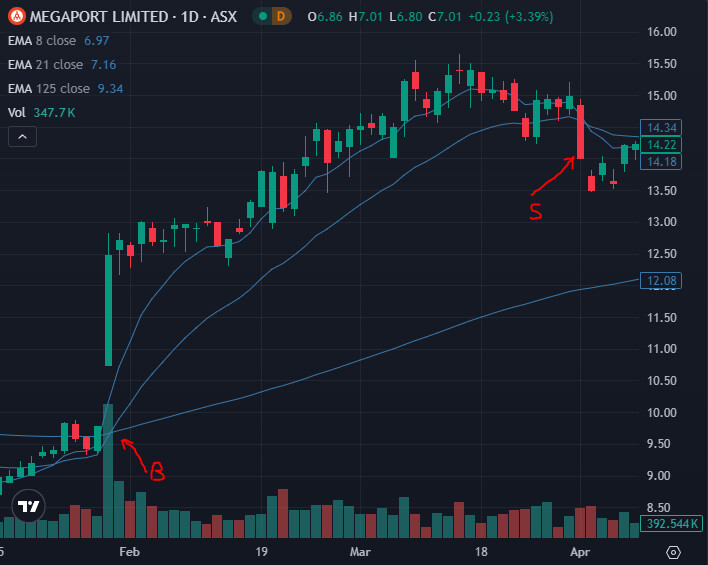
An example of the 3EMA strategy resulting in a profitable trade in Megaport. An entry was taken upon the 10-day EMA crossing the 21 and 125-day EMA’s. This was further supported by an increase in volume and the fact that fundamentally, the company was exhibiting signs of turning around. Those 3 conditions made this a high probability trade. An exit was taken once the 10-day EMA crossed the 21-day EMA. Trades could have been executed on the day of the signal generation for the investor who was on the market at the time and perhaps had been anticipating such a move. Otherwise, entries and exits can be taken the following day, at the opening price.
The 3EMA Change Report provides a list where the moving averages have crossed in the last 3 days from a list of around 500 companies.
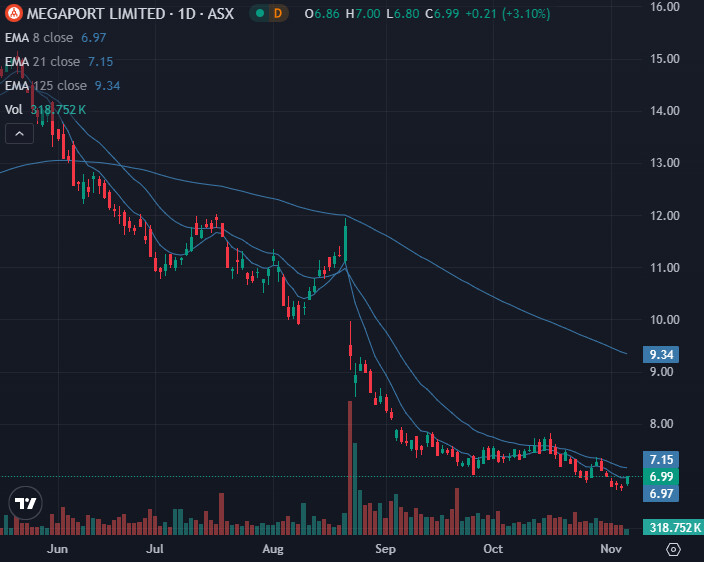
Today the price in MP1 is $6.99. While following this strategy provided a strong profit, it also prevented suffering a large loss. Another advantage of the strategy is that it keeps you out of falling stocks and prevents you from trying to “catch a falling knife”.
Commonwealth Bank ASX:CBA
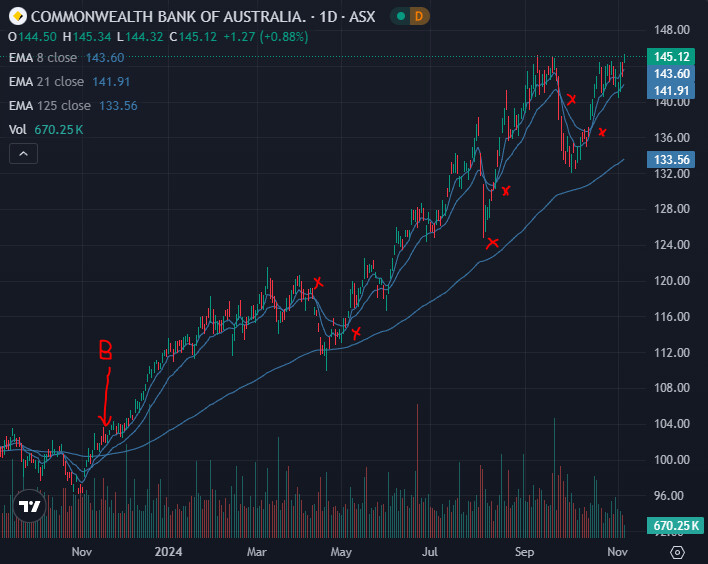
A buy signal was generated using the approach at the end of November 2023 at around $104. Longer-term investors using the 10-day / 21-day / 125-day moving average cross-over sell signal would still be holding that original buy position. The shorter-term trader, would have made 3 closed trades, all of which would have been profitable. They would also be currently in a position in Commonwealth Bank.
Best Applications
The 3EMA crossover strategy works well in trending markets with clear up or down movements. When the 10-day EMA is above the 21-day and 125-day EMAs, it typically signals an established uptrend. The exit signal occurs when the 10-day EMA crosses below the 21-day EMA, capturing profits as the trend begins to reverse. Traders report higher success rates using this approach with assets that trend for longer periods, such as growth stocks or commodities. The 125-day EMA provides a long-term trend threshold, aligning with which often helps capture extended trends.
Limitations
The strategy struggles in choppy or sideways markets, where frequent EMA crossovers result in multiple unprofitable trades and potentially high transaction costs. To avoid this, some traders require a minimum number of closing prices above the 125-day EMA before entering a trade, reducing noise from minor fluctuations.
Disclaimer: This information is provided purely for educational purposes. It takes no account of an individual’s personal financial circumstances and hence can in no way constitute financial advice. The above data may be subject to errors or inconsistencies for which the author takes no liability. It is imperative that all investors do their own research or if they need advice, seek it from a qualified financial adviser.
3EMA Trading Strategy
Quick Take: QCFSep24 (ASX:DRO)
This content is restricted to supporters of stocksunderthehood.com
ETFs: Are They Distorting Financial Markets?
This is a restricted members post.
Quick Take: Oct2024 ASX:ZIP
This content is restricted to supporters of stocksunderthehood.com
Beamtree Holdings (ASX:BMT) Analysis
This is a restricted members post.
What to buy?
Introduction
Buying is the fun and easy part. It’s really not that hard to find stocks that are going up and simply “jump on the bus.” I guess the art for the investor, as opposed to the trader, is finding stocks that have the greatest potential to go up for as long as possible.
Buying is a two step process for me. The first step is identifying a universe of companies that I want to own. The second step is trying to determine the best time to buy those companies. In this article, I focus of the first step – What to buy?
On this site, I have two model portfolios. The aim of the Quality Model Portfolio is to find those stocks that have the greatest potential to go up for as long as possible. The aim of the Growth Model Portfolio is to find the stocks that are likely to go up the most in the near term. The magic happens, when a stock from the Growth Model Portfolio graduates to the Quality Model Portfolio. Even better if it can feature on both.
The stocks in these two portfolio’s provide an answer to the first step of my process. They provide the “What to buy?”
Growth Stock Criteria
-
- Upward Share Price Trend
- Current Revenue per share growth
- Current Earnings Before Tax per share growth
- Operating Cash Flow per share growth
- Outlook for continued Revenue Growth
- Outlook for continued Earnings Growth in the form of EBITDA.
Once these stocks have been identified, it’s a matter of sorting those that are growing the fastest.
The churn in this portfolio is greater than in the Quality Model Portfolio because there are more stocks here that haven’t yet built a history of performance. They may be just getting started or are turnaround stories. Companies in this portfolio simply have more false starts. However, those that can maintain their growth trajectories, even for just a year or two, can provide significant upside in a short amount of time. Those that can sustain it for even longer have the greatest potential to become future market leaders.
An example of a stock that met my Growth Criteria early on was Tuas ASX:TUA. In April 2023, I took a position at around $1.50. Today they remain in the Growth Portfolio and have also graduated to Quality Portfolio. The stock is $5.30 at the time of writing.
Quality Growth Stock Criteria
- The criteria are similar to the Growth Stock Criteria, with the addition of some other requirements:
- Low Debt
- A history of very high Revenue per share growth consistency OR a history of very high Earnings per share growth consistency
- More than a Single Analyst covering the stock, providing the forward projections I use in my analysis
- Operating Cash Flow positivity
- Profitable on a Pre-Tax Earnings basis
Once again, stocks that meet the criteria are then sorted according to their earnings potential.
Where’s Valuation?
As a growth and momentum investor, I do not factor valuation into my criteria. This may surprise or not appeal to many, given that we’ve all been told to buy stocks when they’re cheap and sell when they become expensive. I’m not saying that approach is wrong, but I’ve found it very difficult to execute.
I’ve always been pretty good at the “buying cheap” part of the equation. The challenge has been in selling when a stock appears expensive, which has cost me more than I’d like to admit. A good example is selling Pro Medicus when it was under $40. At the time, it looked expensive, and now with the share price around ~$180, it looks even more expensive. I also mentioned Tuas earlier. With a price-to-sales ratio of 17 times and no after-tax profits, it looks very expensive. The old me would have sold long ago. Today, I continue to hold, though I’ve trimmed my position once or twice to maintain proper portfolio balance.
Now, I let the market determine valuation, not a formula or opinion. I trust the market to signal when Pro Medicus or Tuas becomes too expensive, which will happen when their prices drop enough to trigger my trailing stop-loss. This shift has allowed me to hold onto my winners much longer, addressing one of the biggest weaknesses I identified in my strategy before becoming a full-time investor in 2021. For more on this, refer to “When to Sell.”
Company Dashboard For Quick Reference
The criteria described above are displayed on the Company Dashboards that I use when creating my Company Reports. The dashboard has been developed to speed up the process of identifying whether a stock is a good candidate for investment. If I see eight ticks, I will proceed to look more closely. If I don’t see eight but maybe just six or seven, I can quickly identify which areas the company may be lacking in and assess whether it is still worth keeping an eye on them for the future. A company that only has a few ticks can easily be disregarded and time and effort can be directed elsewhere. A stock in a downtrend (i.e. the black price line is heading down and in the dark red zone) can easily be avoided until the market suggests it’s worth looking at. One clear goal of my approach is to not be stuck in falling stocks.

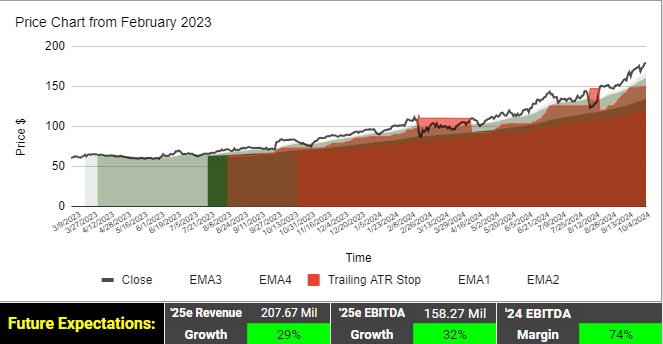
Disclaimer: This information is provided purely for educational purposes. It takes no account of an individual’s personal financial circumstances and hence can in no way constitute financial advice. The above data may be subject to errors or inconsistencies for which the author takes no liability. It is imperative that all investors do their own research or if they need advice, seek it from a qualified financial adviser.
What to buy?
QUALITY Model Update 6
This is a restricted members post.